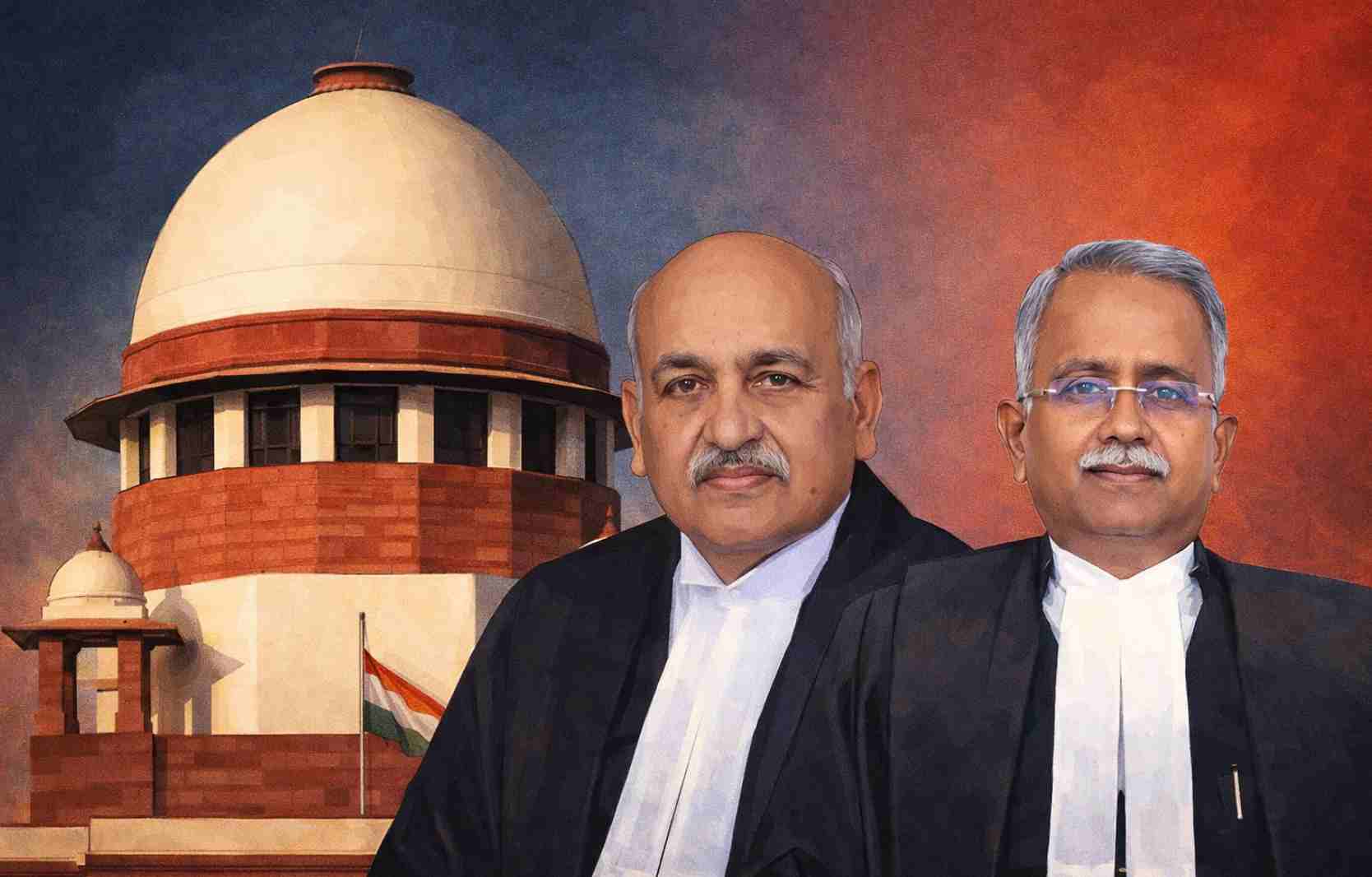
The Supreme Court has upheld the invalidation of two sale deeds executed on the strength of a disputed power of attorney, ruling that a notarised photocopy of such a document cannot be relied upon unless the legal requirements for admitting secondary evidence are strictly followed.
Case Details
- Case Title: Tharammel Peethambaran and Another v. T. Ushakrishnan and Another
- Court: Supreme Court of India
- Bench: Justice Pankaj Mithal and Justice S.V.N. Bhatti
- Date of Judgment: February 6, 2026
- Citation: 2026 INSC 134
- Appeal: Civil Appeal arising out of SLP (C) No. 11868 of 2024
Case Background
The dispute arose from intra-family transactions concerning three items of immovable property in Kozhikode.
The plaintiff, the owner of the suit properties, resided in Mumbai, while the first defendant, her brother-in-law, had the house situated on one of the properties.
According to the plaintiff, she executed a limited power of attorney (PoA) in July 1998, authorising the first defendant only to manage the property.
She denied granting any authority to mortgage or alienate the land. In March 2007, the first defendant executed two registered sale deeds in favour of the second and third defendants, claiming authority under the PoA.
Upon learning of the sales, the plaintiff cancelled the PoA and instituted a suit seeking a declaration that the sale deeds were void, along with an injunction and recovery of possession.
Disputed Power of Attorney and Sale Deeds
Central to the controversy was whether the PoA executed by the plaintiff empowered the first defendant to sell the property. The plaintiff relied on the original executed PoA, which allegedly excluded clauses relating to sale and mortgage.
The defendants, on the other hand, relied on a notarised photocopy of the PoA, marked as Exhibit B-2, which contained clauses authorising alienation.
The plaintiff alleged that the clauses enabling sale had been interpolated later and that the photocopy relied upon by the defendants was a fabricated document. She also denied executing receipts acknowledging payment of ₹11 lakh towards sale consideration.
Findings of the Trial Court
The Trial Court closely compared the draft PoA sent to the plaintiff with the disputed photocopy relied upon by the defendants. It found that words authorising “sale” appeared to have been added later, noting differences in spacing and lack of textual cohesion.
The court also recorded that the original PoA was never produced by the defendants, despite being in their custody.
Holding that the PoA was unregistered, unauthenticated, and not proved in accordance with law, the Trial Court declared the sale deeds void, granted an injunction, and directed the first defendant to vacate the house.
First Appellate Court’s Reversal
The District Judge reversed the Trial Court’s decree, holding that the plaintiff had in fact executed a valid PoA authorising sale.
The appellate court relied on the notarised photocopy as secondary evidence, drew presumptions under the Notaries Act and the Evidence Act, and also accepted the defendants’ claim that the plaintiff had received sale consideration through two receipts.
It further inferred authority to sell from the possession of original title deeds by the first defendant and upheld the validity of the sale deeds executed in 2007.
High Court’s Intervention
In the second appeal, the High Court restored the Trial Court’s decree.
It held that the First Appellate Court had relied on inadmissible evidence by treating the notarised photocopy of the PoA as proof without compliance with Sections 65 and 66 of the Indian Evidence Act.
The High Court also endorsed the Trial Court’s finding that the alleged clauses authorising sale lacked cohesion with the rest of the document and bore signs of interpolation.
Consequently, it held that the first defendant had no authority to alienate the property and that the sale deeds were void.
Supreme Court’s Analysis
Dismissing the civil appeal, the Supreme Court affirmed the High Court’s approach and findings. The Court reiterated that the burden lay squarely on the first defendant to prove that he was authorised to sell the property.
The Bench explained that a photocopy of a document is, at best, secondary evidence and cannot be relied upon unless foundational facts for its admission are established. It underscored that secondary evidence is an exception to the rule requiring proof by primary evidence.
The Court laid down detailed principles governing the admissibility of secondary evidence, emphasising that:
“A photocopy of a document is no evidence unless the same is proved by following the procedure set out under the Evidence Act.”
It held that the defendants had failed to establish the existence and due execution of the original PoA, or to explain its non-production.
In such circumstances, presumptions under Section 85 of the Evidence Act or Section 33 of the Registration Act could not be invoked.
Improper Reliance on Inadmissible Evidence
The Supreme Court also found fault with the First Appellate Court for comparing disputed signatures on the receipts without expert assistance, observing that courts should not undertake such a comparison when the admitted signatures themselves are not beyond doubt.
It concluded that the appellate court had relied on “no evidence” by acting upon an unproven photocopy of the PoA, rendering its findings perverse.
The High Court, therefore, acted within its jurisdiction under Section 100 of the Code of Civil Procedure in correcting the error.
Final Decision
The Supreme Court held that the High Court had rightly interfered with the First Appellate Court’s judgment on account of reliance on inadmissible evidence and misapplication of settled legal principles.
Finding no merit in the appeal, the Court dismissed it and upheld the declaration that the sale deeds were void, with no order as to costs.
Follow Mahamana News For More Recent Judgments
Tharammel Peethambaran and Another v. T. Ushakrishnan and Another