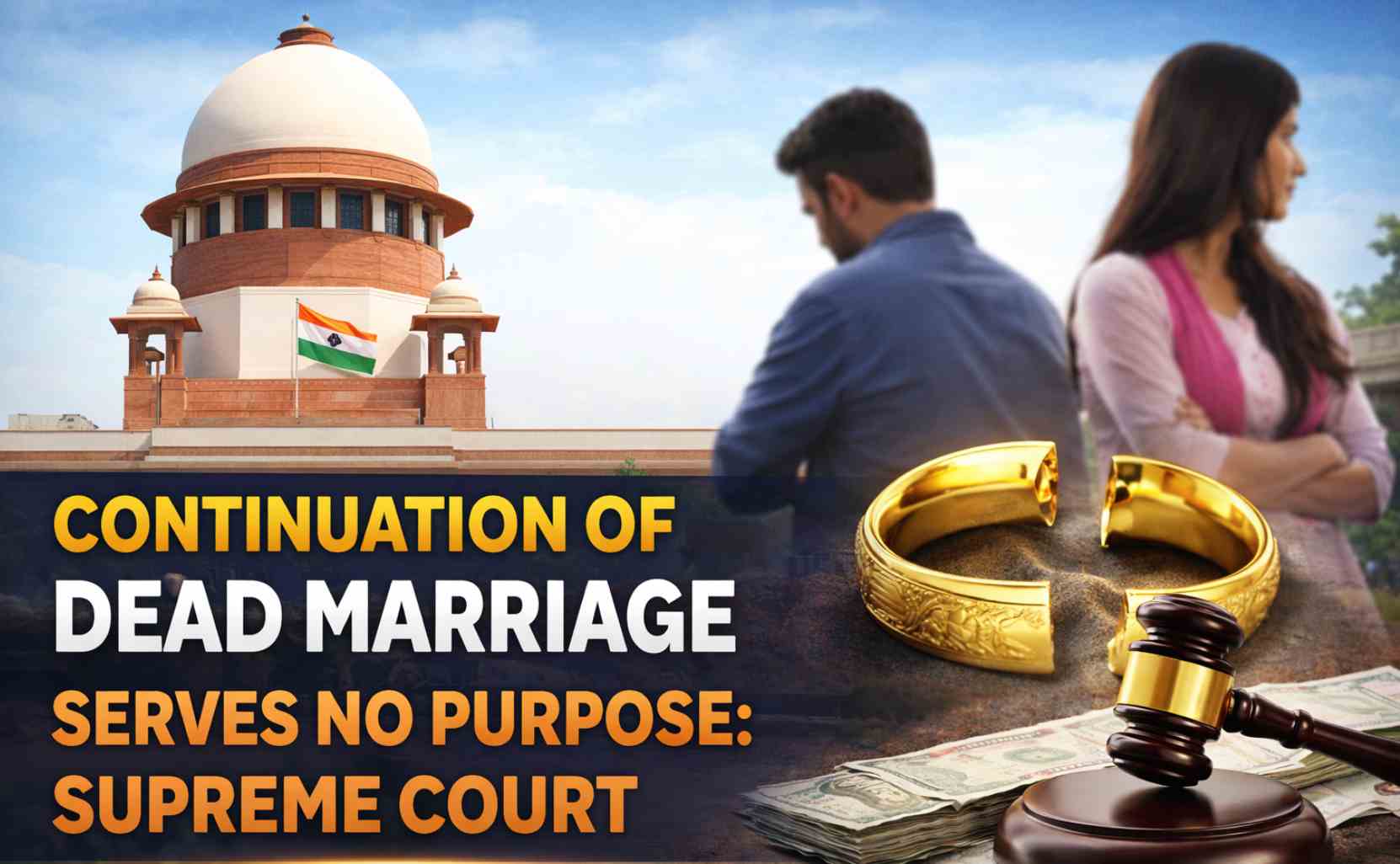
The Supreme Court on December 18, 2025 dissolved the marriage between a government school teacher couple from Punjab, invoking its extraordinary powers under Article 142 of the Constitution after finding that the marriage had irretrievably broken down following nearly two decades of separation, and directed the husband to pay ₹20 lakh as permanent alimony in a one-time settlement.
Case Details
- Case Title: Jatinder Kumar v. Jeewan Lata
- Court: Supreme Court of India
- Bench: Justice Vikram Nath and Justice Sandeep Mehta
- Date of Judgment: December 18, 2025
- Case Number: Civil Appeal No. of 2025 (arising out of SLP (C) No. 35588 of 2025 @ D. No. 17190 of 2024)
- Citation: 2025 INSC 1463 (Non-reportable)
Background of the Dispute
The appeal before the Supreme Court arose from a long-standing matrimonial dispute between the parties, both of whom are teachers employed in government schools in Punjab.
The marriage between the appellant-husband, Jatinder Kumar, and the respondent-wife, Jeewan Lata, was solemnised on June 22, 2003, at Morinda in District Ropar, Punjab. No child was born out of wedlock.
According to the husband, the marital relationship was strained almost from its inception.
After marriage, the wife continued working as a teacher in a government elementary school at Hansron, Tehsil Nawanshahr.
In October 2004, the couple shifted to Ropar following the husband’s posting at a government senior secondary school at Kariha.
The husband alleged that matters deteriorated further after he met with an accident in February 2005.
He claimed that during the period of his medical treatment, which lasted about a week, the wife neither attended to him nor provided any care.
He further alleged that she attempted to coerce him into signing certain documents, prompting him to file a civil suit seeking an injunction against her and her family members.
That suit was eventually withdrawn following a compromise between the parties.
In November 2005, the parties moved back to Nawanshahr. Shortly thereafter, the wife left the matrimonial home and did not return, marking the beginning of a prolonged separation that continued for nearly twenty years by the time the matter reached the Supreme Court.
Proceedings Before the Trial Court and High Court
Following the separation, the husband initiated legal proceedings under the Hindu Marriage Act, 1955. He first filed a petition under Section 9 of the Act seeking restitution of conjugal rights.
That petition, however, was dismissed as withdrawn by the trial court on October 13, 2007.
Subsequently, on December 14, 2009, the husband filed a petition under Section 13 of the Hindu Marriage Act, seeking dissolution of marriage on the grounds of cruelty and desertion.
He reiterated allegations regarding the wife’s conduct, including her alleged neglect during his illness and her departure from the matrimonial home without cause.
The trial court, however, was not persuaded. By its order dated August 14, 2012, the Additional District Judge, Shaheed Bhagat Singh Nagar, dismissed the divorce petition, holding that the husband had failed to substantiate the allegations of cruelty and desertion against the wife.
Aggrieved by the dismissal, the husband preferred an appeal before the Punjab and Haryana High Court.
The High Court, by its judgment dated February 28, 2014, in FAO No. M-246 of 2012, affirmed the findings of the trial court and dismissed the appeal, concluding that no ground was made out to interfere with the trial court’s decision.
It was this order of the High Court that was challenged before the Supreme Court in the present civil appeal.
Submissions Before the Supreme Court
When the matter came up before the Supreme Court, both parties were heard through counsel and also appeared in person. The Court noted that it had interacted with the parties directly during the course of the proceedings.
The husband’s principal submission was that the marriage had irretrievably broken down.
Emphasising that the parties had been living separately for almost two decades, he argued that there was no possibility of reconciliation and that continuing the marital bond would serve no purpose other than prolonging the suffering of both sides.
On this basis, he urged the Court to dissolve the marriage by exercising its powers under Article 142 of the Constitution of India.
The wife, on the other hand, opposed the plea. She denied the allegations of cruelty made against her and contended that her husband had not made sincere efforts to reconcile.
According to her, the facts of the case did not warrant the invocation of Article 142 for granting divorce, particularly when the statutory grounds under the Hindu Marriage Act had not been established before the courts below.
Supreme Court’s Observations on Irretrievable Breakdown
After considering the submissions, the Supreme Court recorded that it was undisputed that the parties had been living separately for about twenty years.
The Bench observed that the strain in the marital relationship was evident from the record and from the husband’s averments.
The Court also took note of the fact that multiple opportunities for settlement had been explored, including a reference to the Supreme Court Mediation Centre, but no amicable resolution could be reached. In this context, the Bench observed that at the present stage, there appeared to be
“no possibility of reconciliation between the parties.”
Significantly, the Court remarked that the continuance of the marital bond in such circumstances would
“serve no meaningful purpose and would only prolong the agony of both parties.”
On this reasoning, the Supreme Court held that the case squarely fell within the category of marriages that had irretrievably broken down, warranting the exercise of its constitutional powers under Article 142 to do complete justice between the parties .
Exercise of Article 142 Powers
Invoking Article 142 of the Constitution, which empowers the Supreme Court to pass such decrees or orders as may be necessary for doing complete justice in any cause or matter pending before it, the Bench decided to dissolve the marriage, notwithstanding the concurrent findings of the trial court and the High Court rejecting the statutory grounds for divorce.
The judgment underscores the Court’s consistent approach in matrimonial matters where prolonged separation and complete breakdown of the relationship are demonstrated, even if the case does not strictly fit within the enumerated grounds under the Hindu Marriage Act.
The Court made it clear that its decision was based on the peculiar facts of the case, particularly the length of separation and the failure of all attempts at reconciliation.
Determination of Permanent Alimony
Having decided to dissolve the marriage, the Supreme Court proceeded to consider the issue of permanent alimony.
The Bench noted that both the husband and the wife were teachers employed in government schools in Punjab and were therefore financially independent to a certain extent.
During the interaction with the parties in court, the husband expressed his willingness to pay a sum of ₹15 lakh as permanent alimony.
However, the Court was of the view that, considering the overall circumstances, including the long duration of separation and the need to secure a just settlement for the wife, a higher amount was warranted.
The Bench held that a sum of ₹20 lakh would be “just and reasonable” as permanent alimony, payable as a one-time settlement.
The amount was directed to be paid by the husband to the wife within a period of two months from the date of the judgment.
The Court further directed that the decree of divorce would be drawn up only after the Registry was furnished with proof of payment of the alimony amount.
The wife was directed to provide the necessary bank details to facilitate the payment.
Closure of All Pending Proceedings
In order to bring a quietus to the long-running dispute, the Supreme Court also directed that any civil or criminal proceedings still pending between the parties would stand closed in view of the settlement and dissolution of marriage.
Allowing the appeal, the Court set aside both the High Court’s order dated February 28, 2014, and the trial court’s order dated August 14, 2012.
The marriage was formally dissolved under Article 142 of the Constitution, subject to compliance with the condition regarding payment of permanent alimony.
Final Directions
The appeal was accordingly allowed. All pending applications were disposed of. The judgment was authored by Justice Vikram Nath and concurred in by Justice Sandeep Mehta, and was pronounced in New Delhi on December 18, 2025.
Follow Mahamana News For More Recent Judgments
Jatinder Kumar v. Jeewan Lata