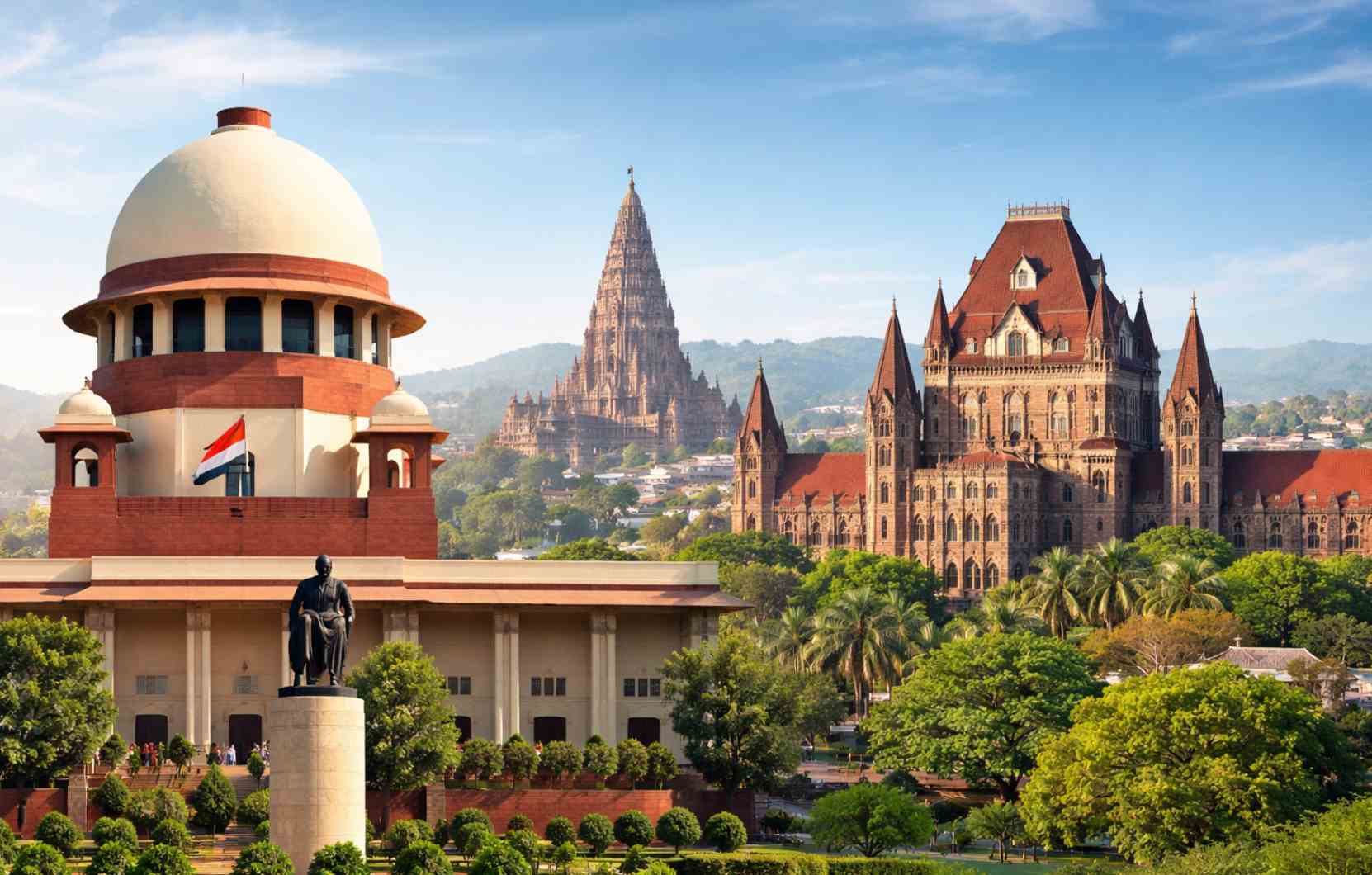
The Supreme Court on Thursday upheld an administrative notification issued by the Bombay High Court appointing Kolhapur as an additional place of sitting for its Judges and Division Courts, holding that the Chief Justice of a High Court has an independent and continuing statutory power under Section 51(3) of the States Reorganisation Act, 1956 to organise such sittings in the interest of convenient administration of justice.
Case Details
- Case Title: Ranjeet Baburao Nimbalkar v. State of Maharashtra & Anr.
- Court: Supreme Court of India
- Jurisdiction: Civil Original Jurisdiction
- Case Number: Writ Petition (Civil) No. 914 of 2025
- Neutral Citation: 2025 INSC 1460
- Date of Judgment: December 18, 2025
- Coram: Justice Aravind Kumar & Justice N.V. Anjaria
- Petitioner: Ranjeet Baburao Nimbalkar
- Respondents: State of Maharashtra & High Court of Judicature at Bombay (administrative side)
- Impugned Action: Administrative Notification No. P.0108/2025 dated August 1, 2025, issued by the Bombay High Court appointing Kolhapur as an additional place of sitting for Judges and Division Courts, with effect from August 18, 2025.
- Statutory Provisions Involved: Section 51(3), States Reorganisation Act, 1956, Articles 14, 21 and 32 of the Constitution of India
Challenge to Kolhapur Sitting Before the Supreme Court
The ruling came in Ranjeet Baburao Nimbalkar v. State of Maharashtra & Anr., a writ petition filed under Article 32 of the Constitution questioning Notification No. P.0108/2025 dated August 1, 2025, issued on the administrative side of the Bombay High Court.
The notification, approved by the Governor of Maharashtra and operational from August 18, 2025, designated Kolhapur as a place where Judges and Division Courts of the High Court could sit.
The petitioner sought quashing of the notification, contending that the decision was unconstitutional, arbitrary, and amounted in substance to the creation of a permanent Bench without following the procedure mandated by Parliament.
Historical Context of Bombay High Court Benches
The judgment, authored by Justice Aravind Kumar for a Bench also comprising Justice N.V. Anjaria, traced the historical evolution of additional sittings and Benches of the Bombay High Court.
Established in 1862, the Court has long exercised jurisdiction over a vast and diverse geographical area.
Following the States Reorganisation Act, 1956 and the reorganisation of States in 1960, statutory mechanisms were introduced to address access-to-justice concerns arising from distance and regional diversity.
Nagpur continued as a permanent Bench; Aurangabad was first established as an additional place of sitting in 1981 under Section 51(3) and later converted into a permanent Bench under Section 51(2) in 1984; and a permanent Bench was set up at Panaji following the extension of the High Court’s jurisdiction to Goa.
Against this backdrop, Kolhapur and the surrounding districts, Sangli, Satara, Ratnagiri, and Sindhudurg, had for decades sought a High Court sitting closer to the region, citing distance from the principal seat at Mumbai and a steady inflow of litigation.
Petitioner’s Case: Alleged Circumvention of Law
Senior Advocate Balbir Singh, appearing for the petitioner, argued that Section 51(3) was never intended to create enduring or permanent institutional arrangements.
He contended that Parliament had consciously differentiated between Section 51(2), which provides for permanent Benches through a Presidential order after consultation, and Section 51(3), which he characterised as a narrow provision meant for temporary or exceptional situations.
According to the petitioner, invoking Section 51(3) to establish a long-term sitting at Kolhapur amounted to “doing indirectly what the statute requires to be done directly” under Section 51(2), thereby defeating legislative intent.
The petitioner further alleged a lack of adequate consultation, arguing that such a decision could not be reduced to a unilateral administrative act of the Chief Justice without Full Court deliberation.
Reliance was placed on past instances where similar proposals in Maharashtra were rejected by committees or the Full Court in 1996, 1997, 2006 and 2018.
Invoking Articles 14 and 21, the petitioner claimed that selecting Kolhapur while excluding other aspirant regions such as Pune or Solapur was arbitrary and discriminatory, and that diversion of judicial resources to an additional sitting would weaken the already overburdened district judiciary rather than enhance access to justice.
Respondents’ Defence: Statutory Power of the Chief Justice
Opposing the petition, Solicitor General of India Tushar Mehta, appearing for the High Court administration, argued that the challenge was founded on a fundamental misunderstanding of the statutory scheme.
He submitted that Section 51(3) confers an independent, continuing power on the Chief Justice of a High Court to appoint additional places of sitting, subject only to the approval of the Governor.
Citing State of Maharashtra v. Narayan Shamrao Puranik (1982), he emphasised that the same provision had earlier been upheld by the Supreme Court in relation to the Aurangabad sitting.
The Solicitor General stressed that the Chief Justice, as head of the High Court, is constitutionally entrusted with matters of internal judicial administration, including sittings of the Court.
He argued that Section 51(3) does not mandate Full Court consultation and that past administrative views cannot create an estoppel against the exercise of statutory power in changed circumstances.
On Articles 14 and 21, the respondents contended that decentralisation of High Court sittings furthers access to justice and that choices between competing regional demands are matters of policy, not constitutional compulsion.
Supreme Court’s Analysis: Scope of Section 51(3)
The Court began by observing that the writ petition could have been dismissed in limine, as it disclosed no clear infringement of fundamental rights.
Nonetheless, given the importance of the issues concerning judicial administration, the Bench examined the challenge in detail.
Interpreting Section 51 of the States Reorganisation Act, the Court underscored the significance of the non obstante clause in sub-section (3).
It held that Parliament deliberately vested a residuary and overriding authority in the Chief Justice to organise High Court sittings “for the more convenient transaction of judicial business.”
Rejecting the argument that Section 51(3) is limited to temporary exigencies, the Court held that the provision is part of a permanent statute and is capable of repeated and continuing exercise.
Relying extensively on Narayan Shamrao Puranik, the Court reiterated that an additional place of sitting under Section 51(3) does not result in territorial bifurcation or confer exclusive jurisdiction, unlike a permanent Bench under Section 51(2).
“The longevity or continuity of a place of sitting appointed under Section 51(3) does not, by itself, convert the exercise of power into one under Section 51(2),” the Court held, adding that permanence is not a statutory criterion under sub-section (3).
Role of the Chief Justice and Consultation
On the question of consultation, the Court emphasised that while internal deliberation is desirable as a matter of institutional prudence, it is not mandated by law under Section 51(3). Where Parliament intended mandatory consultation, as in Section 51(2), it had expressly said so.
The Court reaffirmed settled jurisprudence that the Chief Justice’s opinion in administrative matters is the institutional opinion of the High Court.
Citing Federation of Bar Associations in Karnataka v. Union of India and State of Rajasthan v. Prakash Chand, it held that courts must be slow to interfere with such decisions absent mala fides or statutory violation.
Past Decisions and Change in Circumstances
Addressing the reliance on earlier rejected proposals, the Court held that administrative decisions do not operate as permanent restraints. Such decisions are contextual and may be revisited in light of evolving circumstances, accumulated demand, and improved infrastructure.
“A subsequent decision taking a different view, when informed by changed conditions, does not, by itself, render the exercise arbitrary or unreasonable,”
the Bench observed.
Limited Scope of Judicial Review
The Court reiterated that judicial review in matters of judicial administration is confined to examining legality, not merits.
Interference is warranted only where the decision is ultra vires, mala fide, or manifestly arbitrary.
In the present case, the Court found no such infirmity, noting that the Chief Justice acted within statutory bounds and with the Governor’s approval.
Articles 14 and 21: Access to Justice
Rejecting the Article 14 challenge, the Court held that equality does not require identical or simultaneous accommodation of all regional demands.
The selection of Kolhapur was found to have a rational nexus with the objective of facilitating access to justice for geographically distant districts forming a contiguous region.
On Article 21, the Court relied on Anita Kushwaha v. Pushap Sudan to emphasise that access to justice includes physical accessibility.
It held that decentralisation of High Court sittings, where justified by geography and caseload, advances rather than undermines the constitutional guarantee.
The apprehension about diversion of resources, the Court said, reflected a policy disagreement rather than a constitutional infirmity.
Final Verdict
Concluding that the impugned notification was issued in valid exercise of statutory power, the Supreme Court dismissed the writ petition, holding that no constitutional or statutory violation was made out.
It clarified that the Union Government’s power under Section 51(2) to establish permanent Benches remains unaffected by the exercise of power under Section 51(3).
“There shall be no order as to costs,”
the Court said, bringing to a close the challenge to the Kolhapur sitting of the Bombay High Court.
Follow Mahamana News For More Recent Judgments
Ranjeet Baburao Nimbalkar v. State of Maharashtra & Anr.