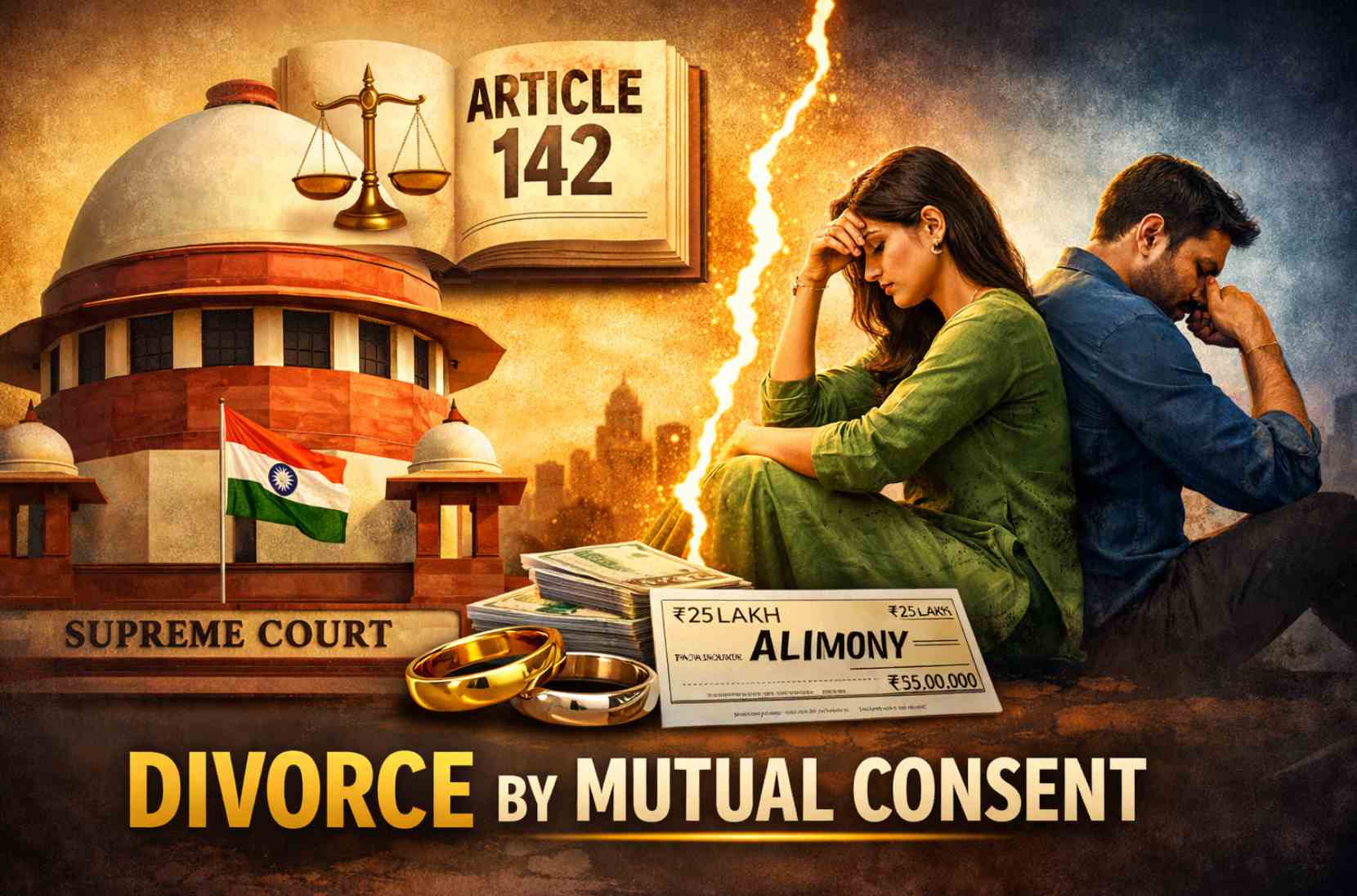
The Supreme Court set aside a decree of divorce granted on the ground of desertion and dissolved the marriage by mutual consent by invoking its extraordinary powers under Article 142 of the Constitution of India, bringing finality to a long-standing matrimonial dispute between working professionals living separately for several years .
Case Details
- Case Title: Bhagyashree Bisi v. Animesh Padhee
- Court: Supreme Court of India
- Bench: Justice Vikram Nath and Justice Sandeep Mehta
- Date of Judgment: December 18, 2025
- Citation: 2025 INSC 1464
- Appeal: Civil Appeal arising out of SLP (Civil) No. 25584 of 2024
- Impugned Order: Judgment dated August 8, 2024, of the High Court of Orissa at Cuttack in MATA No. 279 of 2023
- Originating Case: C.P. Case No. 65 of 2022, Family Court, Sambalpur.
Background of the Matrimonial Dispute
The appellant-wife and the respondent-husband were married on December 14, 2014, at Sambalpur in Odisha. At the time of marriage, the appellant was employed with Infosys and was residing in the United States of America.
She returned to India in February 2017 and thereafter began cohabiting with the respondent in Bangalore. According to the record, marital discord subsequently arose between the parties.
In 2021, the appellant-wife was again deputed by her employer to the United States and travelled abroad.
The respondent-husband later approached the Family Court, Sambalpur, by filing C.P. Case No. 65 of 2022 under Section 13 of the Hindu Marriage Act, 1955, seeking dissolution of marriage on the ground of desertion.
He alleged that the appellant-wife had left the matrimonial home during the intervening night of January 24–25, 2020, and had not returned thereafter, amounting to desertion for a continuous period exceeding two years before the filing of the petition.
The appellant-wife contested these allegations. She asserted that she had left the matrimonial home on January 19, 2020, to visit her brother due to a hostile environment allegedly created by the respondent, including demands for money.
She further stated that on January 20, 2020, she had transferred a sum of ₹3,00,000 to the respondent-husband’s account and denied that her conduct constituted desertion under matrimonial law.
Findings of the Family Court and the High Court
By judgment dated August 5, 2023, the Family Court allowed the husband’s petition and dissolved the marriage by granting a decree of divorce on the ground of desertion.
The court accepted the respondent-husband’s case that the statutory ingredients of desertion had been satisfied.
Aggrieved by the decree, the appellant-wife preferred an appeal before the High Court of Orissa at Cuttack in MATA No. 279 of 2023.
The High Court, by its order dated August 8, 2024, dismissed the appeal and affirmed both the findings of the Family Court and the decree of divorce granted on the ground of desertion.
This led the appellant-wife to approach the Supreme Court by way of special leave, which was granted, resulting in the present civil appeal .
Submissions Before the Supreme Court
The appeal came up for hearing before a Bench comprising Justice Vikram Nath and Justice Sandeep Mehta.
Learned senior counsel appearing for the appellant-wife submitted that although the appellant was agreeable to the marriage being dissolved, she objected to the decree being founded on the ground of desertion.
According to the appellant-wife, she had not abandoned the respondent-husband but had left India due to professional obligations while remaining open to communication.
Significantly, during the course of the hearing, the respondent-husband, through counsel, fairly stated that he too was agreeable to the marriage being dissolved by mutual consent.
He expressed no objection to the Supreme Court exercising its powers under Article 142 of the Constitution of India to dissolve the marriage, instead of sustaining the decree on the ground of desertion as affirmed by the High Court.
Supreme Court’s Observations on Irretrievable Breakdown
After hearing both sides, the Supreme Court took note of the undisputed fact that the parties had been living separately for a considerable length of time.
The Bench recorded that efforts at reconciliation had not yielded any positive outcome and that both parties had unequivocally expressed their desire to bring the marital relationship to an end.
The Court observed that in such circumstances, the marriage had irretrievably broken down and that “there remains no scope for restoration of the matrimonial bond.”
This assessment formed the basis for invoking the Court’s plenary powers to do complete justice between the parties.
Setting Aside the Desertion-Based Decree
In view of the consensual stand taken by both parties, the Supreme Court held that it would be appropriate to set aside the decree of divorce granted on the ground of desertion.
The Bench explicitly stated that the decree on desertion stood set aside and that the marriage would instead be dissolved by exercising the Court’s powers under Article 142 of the Constitution of India, based on the consent of both spouses.
This approach ensured that the dissolution of marriage did not carry a finding of fault against either party, aligning with the mutual consent expressed before the Court and avoiding further acrimony.
Consideration of Permanent Alimony
The Supreme Court then turned to the issue of permanent alimony. It noted that both parties were working professionals and earning well.
The Bench considered it appropriate, in order to bring finality to all claims arising out of the matrimonial relationship, to settle the issue by way of a one-time lump-sum payment.
Taking into account the overall facts and circumstances of the case, including the financial status of both parties and other attendant factors, the Court held that a sum of ₹25 lakh would constitute a just and reasonable amount towards full and final settlement, including permanent alimony.
The amount was directed to be paid within two months and deposited with the Registry of the Supreme Court, with liberty to the appellant-wife to withdraw the same.
Final Directions and Closure of Proceedings
The Court directed that upon receipt of proof of payment of the aforesaid amount, the Registry shall draw up a decree of divorce.
It further ordered that upon compliance with the directions regarding payment, any pending civil or criminal proceedings between the parties arising out of the matrimonial dispute shall stand closed.
With these directions, the civil appeal was disposed of, and all pending applications, if any, were also declared disposed of.
The judgment was authored by Justice Vikram Nath, with Justice Sandeep Mehta concurring, and was pronounced in New Delhi on December 18, 2025.
Follow Mahamana News For More Recent Judgments