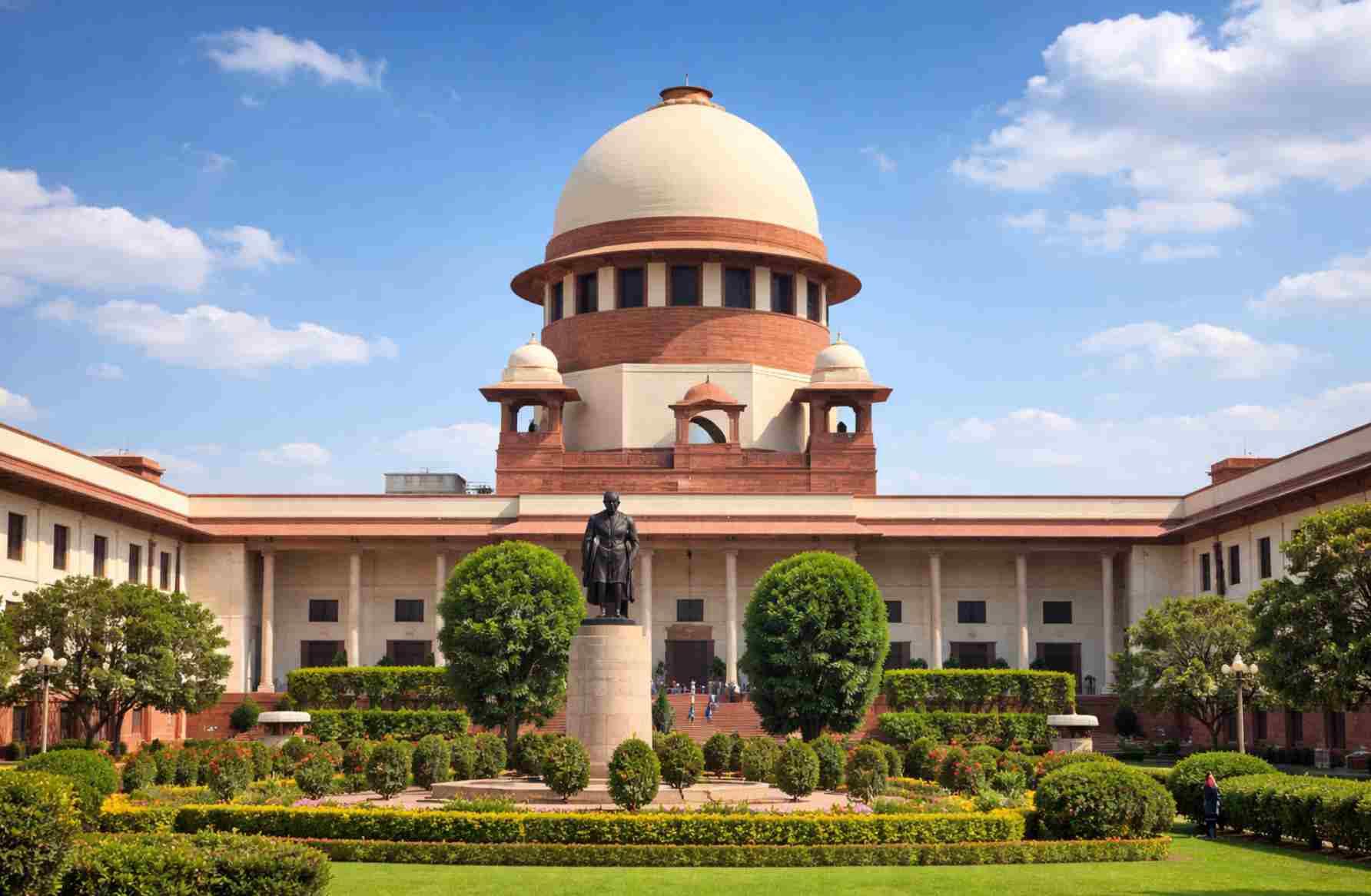
The Supreme Court on 10 March 2026 struck down the Srimati Radhika Sinha Institute and Sachchidanand Sinha Library (Requisition & Management) Act, 2015, holding that the Bihar government’s legislative takeover of the historic Patna library was “manifestly arbitrary” and violative of Article 14 of the Constitution.
The Court ruled that the Act completely dissolved a century-old trust and vested its property in the State without demonstrating any necessity, inquiry, or rational basis for such drastic intervention.
- Case Title: Anurag Krishna Sinha v. State of Bihar & Anr.
- Court: Supreme Court of India
- Bench: Justice Vikram Nath and Justice Sandeep Mehta
- Date of Judgment: 10 March 2026
- Citation: 2026 INSC 219
- Case Type: Civil Appeal No. 13581 of 2025
Background
The litigation concerns the Smt. Radhika Sinha Institute and Sachchidanand Sinha Library, a historic institution founded nearly a century ago in Patna.
The library was established in 1924 by Dr. Sachchidanand Sinha, a prominent statesman who briefly served as the first President of India’s Constituent Assembly. He created the institute in memory of his wife Smt. Radhika Sinha, donating ₹50,000 from the sale of ancestral property and contributing approximately 10,000 books from his personal collection.
A formal Trust Deed was executed in 1926, establishing a trust to manage the institution. The deed provided that the eldest male member of the family would serve as Honorary Secretary and Chief Executive Officer, while the Chief Justice of the Patna High Court would act as an ex-officio trustee. It also stated that if the trust failed, the property would revert to the settlor’s family.
The present appellant, Anurag Krishna Sinha, is the great-grandson of the founder and currently holds the position of trustee and chief executive officer of the trust.
Government Involvement with the Library
In 1955, the Bihar government entered into an agreement with the trust recognizing the institution as a State Central Library. Under that arrangement:
- The trust retained management and control of the institution.
- The State provided financial assistance for its functioning.
However, in 1983, the State attempted to take over the library through an ordinance acquiring the trust and its property. That move was challenged and eventually invalidated by the Supreme Court in 1996, which held that actions taken under the lapsed ordinances were non est in law.
Decades later, the Bihar legislature enacted the 2015 Act, providing for acquisition and management of the institute and library by the State government.
The law dissolved the trust and vested the property, management, and assets of the institution in the State.
Challenge Before the Patna High Court
The appellant challenged the 2015 legislation before the Patna High Court.
The High Court dismissed the writ petition in February 2024, holding that:
- The trust was effectively a public trust.
- The Act was enacted in public interest to ensure better management and development of the library.
- The State was obliged to continue the objects of the trust.
Aggrieved by this ruling, the trustee approached the Supreme Court.
Issues Before the Supreme Court
The Court framed two central questions:
- Whether the 2015 Act was manifestly arbitrary and violative of Article 14 of the Constitution.
- Whether the Act resulted in confiscatory acquisition of property, offending Article 300A read with Article 14.
Supreme Court on Character of the Trust
The High Court had treated the trust as a public trust because the library served the public.
The Supreme Court disagreed with this approach. It held that merely because an institution serves the public does not automatically convert it into a public trust.
The Court noted that the trust deed created identifiable trustees, defined management structures, and even provided for reversion of property to the settlor’s family if the trust failed, features consistent with a private trust arrangement.
Importantly, the Court pointed out that neither party before the High Court had argued that the trust was a public trust, yet the High Court decided the case on that basis without giving parties an opportunity to address the issue.
Supreme Court’s Doctrine of Manifest Arbitrariness
A major portion of the judgment discusses the constitutional doctrine of manifest arbitrariness under Article 14.
The Court traced the evolution of this doctrine through landmark cases including:
- E.P. Royappa v. State of Tamil Nadu
- Maneka Gandhi v. Union of India
- Ajay Hasia v. Khalid Mujib
- Shayara Bano v. Union of India
The bench reiterated that arbitrariness is antithetical to equality, and legislation can be struck down if it is capricious, disproportionate, or lacks rational justification.
No Evidence of Mismanagement
A crucial finding of the Court was that the State failed to demonstrate any mismanagement by the trust.
After examining the original government records, the Court found:
- No correspondence accusing the trust of financial irregularities.
- No allegation that the institution was dysfunctional.
- No inquiry or notice issued to the trustees before the legislative takeover.
The Court said such drastic legislative action cannot be justified based on assumptions never communicated to those affected.
State Librarian’s Role Undermined Government’s Case
The Court also highlighted an inconsistency in the State’s argument.
Under existing arrangements, the State Librarian acted as the ex-officio Chief Librarian responsible for supervision of the library’s administration.
If mismanagement had occurred, the Court observed, the government’s own appointee would have been responsible for supervising the institution. Yet no action was ever taken against the State Librarian.
This weakened the State’s claim that mismanagement justified the takeover.
Investment After Takeover Not a Justification
The State argued that after the Act it had invested over ₹72 crore in renovation, modernization, and infrastructure for the library.
The Court acknowledged the importance of preserving such institutions but rejected the argument that investment justified acquisition.
It held that the State could have achieved the same objectives through:
- financial assistance,
- regulatory oversight,
- grants-in-aid,
- statutory audits.
Complete takeover of the trust was therefore unnecessary and disproportionate.
Compensation Provision Declared Confiscatory
The Court was particularly critical of Section 7 of the Act, which allowed the government to pay compensation up to a maximum of one rupee for acquisition of the property.
The bench held that a scheme permitting acquisition while reducing compensation to a token amount is illusory and confiscatory, violating constitutional standards under Article 300A.
Legislative History Raised Further Concerns
The Court also took note of the 1983 ordinance attempt to acquire the same institution, which had earlier failed in judicial scrutiny.
The 2015 Act, the Court said, sought to achieve substantially the same outcome decades later without any new circumstances or justification.
This legislative history further reinforced the finding of arbitrariness.
Supreme Court’s Final Ruling
The Court ultimately held that the 2015 Act:
- dissolved a long-standing trust,
- vested all property in the State,
- provided illusory compensation,
- and lacked any demonstrated necessity.
Such legislation, the Court concluded, was “excessive, unreasoned and disproportionate” to its stated objective of better management.
Accordingly, the Supreme Court:
- Set aside the Patna High Court judgment of 29 February 2024.
- Declared the Srimati Radhika Sinha Institute and Sachchidanand Sinha Library (Requisition & Management) Act, 2015 unconstitutional.
- Restored the trust and its management rights to the original trustees.
However, the Court clarified that the State government remains free to provide financial assistance, administrative support, or regulatory oversight in accordance with law.
Follow Mahamana News For More Recent Judgments