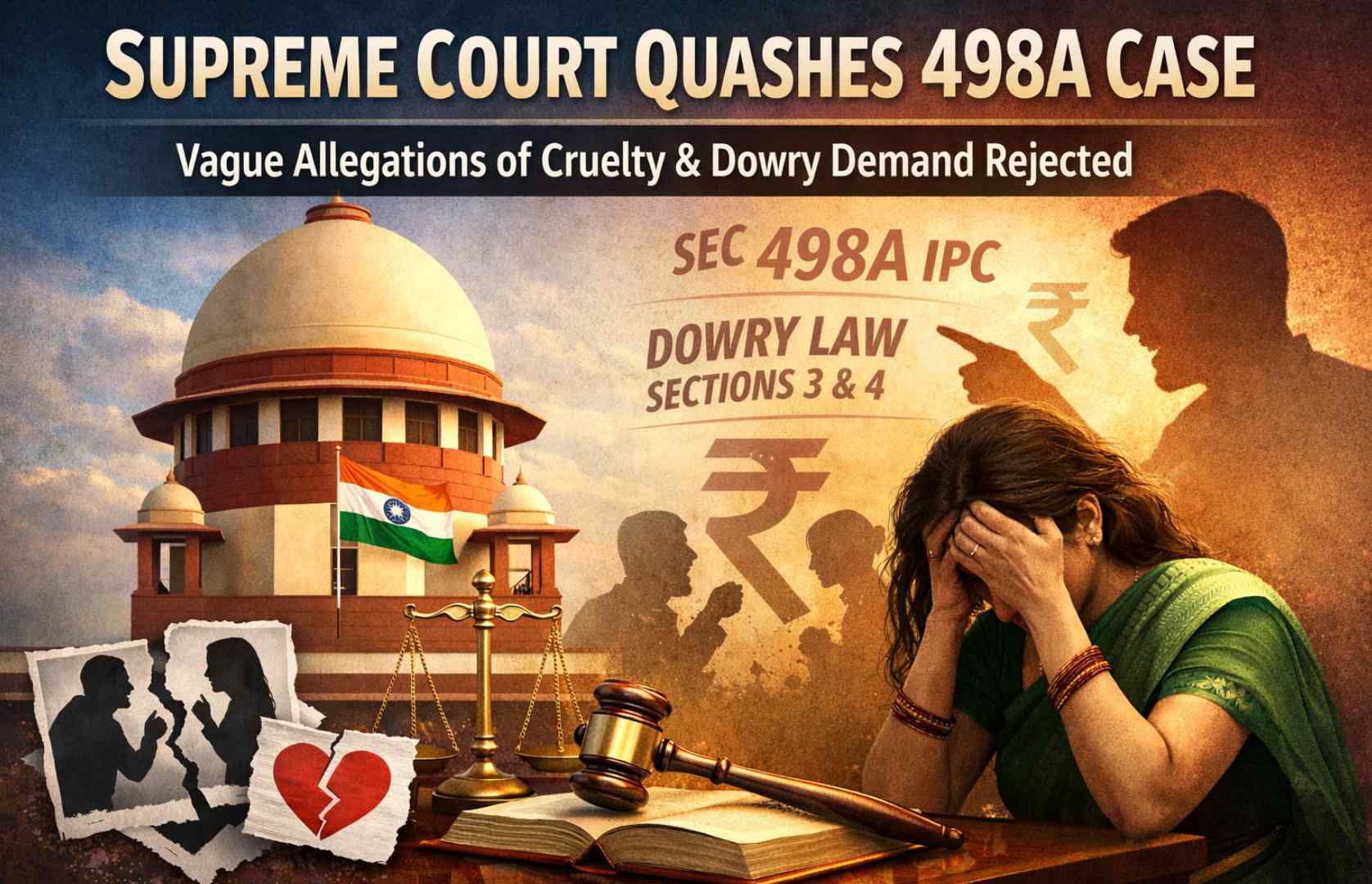
The Supreme Court on December 19, 2025, quashed criminal proceedings against a husband accused of cruelty and dowry harassment under Section 498A of the Indian Penal Code and Sections 3 and 4 of the Dowry Prohibition Act, holding that the allegations reflected ordinary matrimonial discord and lacked the specific particulars necessary to justify a criminal trial.
Case Details
- Case Title: Belide Swagath Kumar v. State of Telangana & Another
- Court: Supreme Court of India
- Bench: Justice B.V. Nagarathna and Justice R. Mahadevan
- Date of Judgment: December 19, 2025
- Citation: 2025 INSC 1471
- Appeal From: Order dated April 27, 2023 of the High Court for the State of Telangana
Background of the Dispute
The appeal arose from an order of the Telangana High Court refusing to quash criminal proceedings initiated against the appellant-husband under Section 498A IPC and Sections 3 and 4 of the Dowry Prohibition Act.
The proceedings stemmed from FIR No.29 of 2022 registered at the Saroornagar Women Police Station, Rachakonda District, and the consequent Complaint Case No.1067 of 2022 pending before the Additional Metropolitan Magistrate-cum-Additional Junior Civil Judge, Ranga Reddy District.
The complainant-wife and the appellant-husband, both software engineers employed in the United States, were married on December 4, 2016, at Tirumala in Andhra Pradesh.
After marriage, they lived together in Michigan, USA, and a son was born to them on April 26, 2019. Matrimonial discord subsequently arose, following which the wife returned to India with the minor child and began residing with her parents in Hyderabad.
In January 2022, after the husband issued a legal notice seeking restitution of conjugal rights, the wife lodged a criminal complaint alleging cruelty and dowry demands by the husband and his family members.
Based on this complaint, the police registered the FIR and later filed a chargesheet against the husband and his relatives.
Proceedings Before the High Court
The husband moved the High Court under Section 482 of the Code of Criminal Procedure, seeking quashing of the FIR and the criminal case.
The High Court, by its order dated April 27, 2023, declined to interfere, observing that the allegations warranted a trial and that the inherent jurisdiction could not be exercised at that stage.
Significantly, the husband’s parents and other relatives, arrayed as accused Nos.2 to 6, had earlier approached the High Court separately.
Their petition was allowed in April 2025, resulting in the quashing of proceedings against them. The husband alone continued to face prosecution, prompting the present appeal before the Supreme Court.
Allegations in the FIR
The complaint alleged that after an initial period of marital harmony, the husband and his family began subjecting the complainant to physical and mental harassment to extract dowry for repaying family debts.
It was further alleged that the husband exercised complete financial control over her, insisted on detailed accounts of household expenses, and failed to provide financial support after she returned to India.
The complainant also claimed neglect during pregnancy and postpartum periods, coupled with taunts regarding her weight, and alleged that a dowry demand of ₹1 crore had been made.
Legal Provisions Involved
The case primarily involved Section 498A of the IPC, which criminalises cruelty by a husband or his relatives, and Sections 3 and 4 of the Dowry Prohibition Act, dealing respectively with the giving or taking of dowry and the demand for dowry.
The Court reproduced the statutory text and reiterated that “cruelty” under Section 498A must fall within the specific contours defined in the Explanation to the provision.
Supreme Court’s Analysis
The Court emphasised that criminal law must not be invoked casually in matrimonial disputes and that allegations under Section 498A IPC require careful scrutiny to prevent abuse of process.
Examining the FIR and the chargesheet, the Bench found that the allegations were vague, omnibus, and lacking in specific instances that could constitute cruelty within the meaning of the statute.
Justice Nagarathna, writing for the Bench, observed that allegations such as sending money to parents, insisting on maintaining accounts of expenses, or exhibiting financial dominance, without evidence of tangible mental or physical harm, could not be elevated to criminal cruelty.
The Court remarked that such conduct, even if unpalatable or reflective of poor marital behaviour, did not satisfy the statutory threshold required to sustain prosecution under Section 498A IPC.
The Bench noted that the complaint failed to specify particular acts, dates, or circumstances demonstrating harassment or coercion connected to unlawful dowry demands.
The assertion of a ₹1 crore demand was unsupported by any material particulars. In the Court’s words, “the term ‘cruelty’ cannot be established without specific instances,” and criminal proceedings cannot rest on generalised allegations alone.
Reliance on Precedent
The Supreme Court relied heavily on the principles laid down in State of Haryana v. Bhajan Lal, particularly the categories enumerated for exercising inherent powers to quash criminal proceedings.
It held that the present case squarely fell within the categories where allegations, even if accepted at face value, did not constitute an offence and where proceedings appeared to be motivated by mala fide intent.
The Court also referred to its recent decision in Dara Lakshmi Narayana v. State of Telangana, reiterating judicial caution against the routine implication of husbands and their families in criminal cases arising from matrimonial discord without specific allegations of active involvement.
Findings and Conclusions
After a comprehensive examination of the record, the Supreme Court concluded that permitting the prosecution to continue would amount to an abuse of the criminal process. It held that the High Court had erred in refusing to exercise its inherent jurisdiction to quash the proceedings.
Accordingly, the Court set aside the impugned order of the Telangana High Court and quashed FIR No.29 of 2022 and all consequential proceedings in Complaint Case No.1067 of 2022 against the appellant-husband.
Final Directions
Allowing the appeal, the Supreme Court clarified that its observations were confined to the criminal proceedings and would not affect any matrimonial or other civil disputes pending between the parties, which were to be decided independently on their own merits in accordance with law.
Follow Mahamana News For More Recent Judgments
Belide Swagath Kumar v. State of Telangana & Another