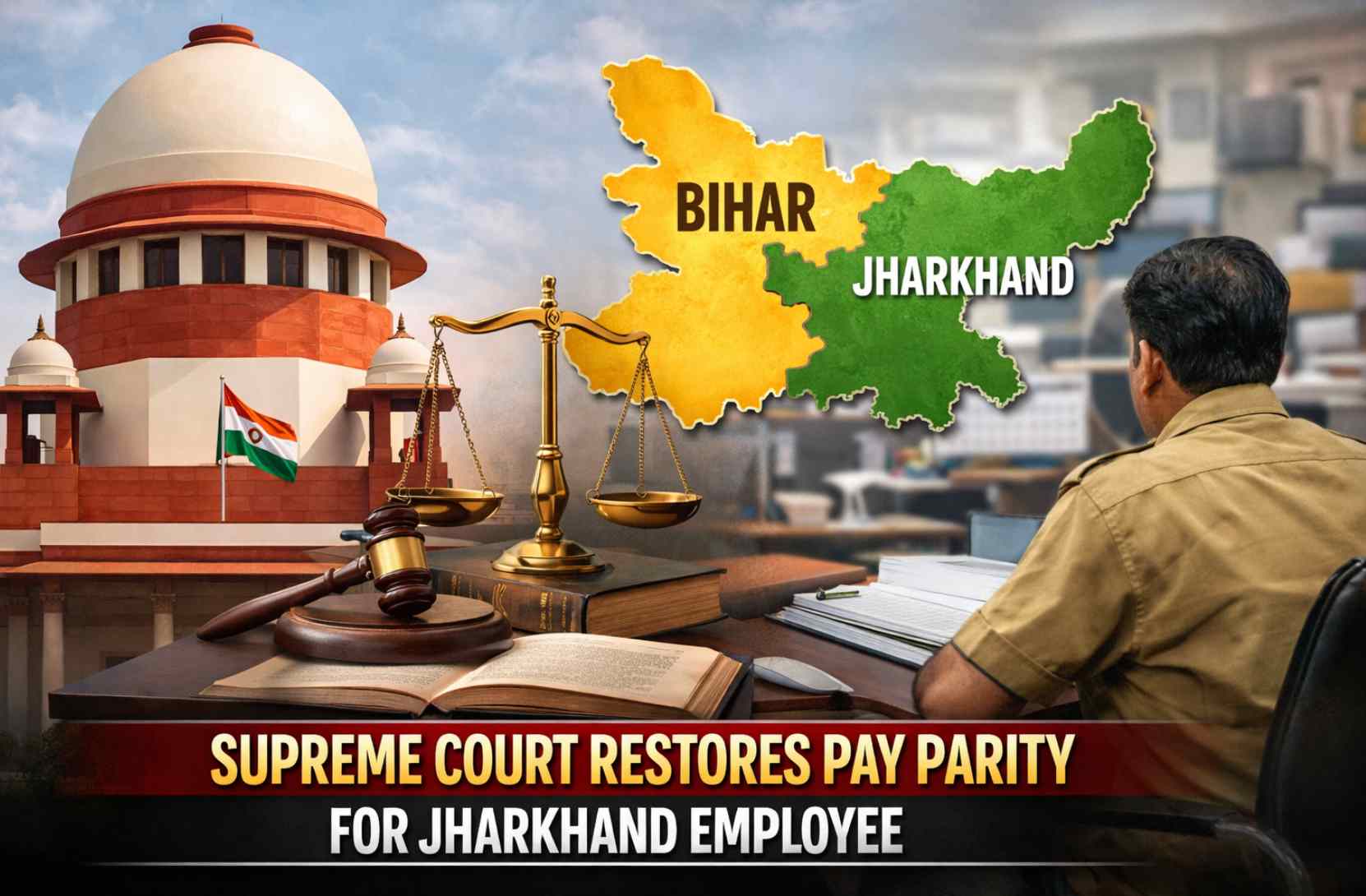
The Supreme Court has allowed a civil appeal filed by an employee of the Industries Department, restoring a Single Judge’s order that granted him parity in pay scale with similarly situated employees, and holding that judgments of the Patna High Court delivered prior to the bifurcation of Bihar are binding on the successor State of Jharkhand under the Bihar Reorganisation Act, 2000 .
Dispute Over Higher Pay Scale After Removal of Anomaly
The appeal arose from a judgment dated 30 March 2022 passed by a Division Bench of the Jharkhand High Court in LPA No. 269 of 2012, which had set aside an earlier order of a Single Judge granting a higher pay scale to the appellant, Sanjay Kumar Upadhyay.
The appellant was appointed as an Industries Extension Officer pursuant to a common competitive examination conducted in 1981 by the Bihar State Subordinate Services Selection Board for sixteen graduate-level non-gazetted Class-III posts across different departments.
Although all sixteen posts were filled through a single recruitment process and were originally placed in the same pay scale, an anomaly emerged following the Fourth Pay Revision.
Ten of the posts were placed in a higher revised scale, while six posts, including that of Industries Extension Officer, were placed in a lower scale.
This disparity continued even after subsequent pay revisions, despite recommendations by pay anomaly and fitment committees acknowledging the anomaly.
Earlier Litigation Before Patna High Court
The anomaly had earlier been examined by the Patna High Court in Nagendra Sahani v. State of Bihar, where a Division Bench held that there was no reasonable classification justifying the grant of different pay scales to employees recruited through the same examination.
The Patna High Court directed that all incumbents of the sixteen posts be placed in the higher pay scale of ₹1600–2780 and observed that similarly situated persons need not approach the court individually for the same relief.
The appellant relied on this judgment, as well as on recommendations of the Fitment Appellate Committee headed by Justice (Retd.) Aftab Alam, who had recommended a uniform revised scale of ₹ 5,000–₹ 8,000 for all sixteen posts. His representations to the authorities were rejected in September 2004.
Following the creation of the State of Jharkhand under the Bihar Reorganisation Act, 2000, the appellant’s services were allocated to Jharkhand.
He thereafter approached the Jharkhand High Court by filing a writ petition in 2005 seeking parity in pay scale.
Single Judge Grants Relief; Division Bench Reverses
A Single Judge of the Jharkhand High Court allowed the writ petition in December 2011, holding that the appellant’s case was squarely covered by the Patna High Court judgments and directing revision of his pay scale from the date of appointment with consequential benefits.
However, the Division Bench, in its 2022 judgment, reversed the Single Judge’s order.
It held that the writ petition suffered from inordinate delay of nearly twenty years, that the appellant had not challenged the rejection of his representation dated 13 September 2004, and that granting retrospective benefits could have a cascading financial effect on the entire cadre.
The Division Bench further observed that Patna High Court judgments could only have persuasive value for Jharkhand.
Supreme Court Examines Binding Effect of Pre-Bifurcation Judgments
Allowing the appeal, the Supreme Court examined whether the judgment in Nagendra Sahani was binding on the State of Jharkhand and whether the appellant’s claim was barred by delay and laches.
The Court placed significant reliance on Section 34(4) of the Bihar Reorganisation Act, 2000, which provides that orders passed by the Patna High Court before the appointed day
“shall for all purposes have effect, not only as an order of the High Court at Patna, but also as an order made by the High Court of Jharkhand.”
The Bench held that this deeming provision was of “seminal importance” and ensured continuity of judicial authority after state reorganisation.
“The judgment in Nagendra Sahani, though rendered by the High Court at Patna… must be treated by virtue of Section 34(4) as binding precedent of the High Court of Jharkhand,”
the Court held.
The Supreme Court found fault with the Division Bench for treating the Patna High Court judgment as merely persuasive and ignoring the doctrine of judicial discipline.
It held that once the factual matrix and legal issues were identical, the Division Bench was bound either to follow the earlier judgment or refer the matter to a larger Bench.
Delay and Laches Not Applicable to Continuing Cause of Action
On the issue of delay, the Court held that claims relating to pay fixation and removal of anomalies constitute a continuing cause of action.
Relying on M.R. Gupta v. Union of India, the Bench reiterated that every month an employee is paid a lesser salary due to incorrect pay fixation gives rise to a fresh cause of action.
The Court noted that the appellant had made representations in 2001 and 2002, which were rejected only in 2004, and that the writ petition was filed in 2005.
It rejected the Division Bench’s conclusion that the appellant had slept over his rights, observing that he had pursued remedies before approaching the court.
Parity for Similarly Situated Employees
The Supreme Court also emphasised that the State had failed to show any distinguishing factor between the appellant and other employees who had already been granted the higher pay scale.
Citing its earlier decision in Suprita Chandel v. Union of India, the Court reiterated that once a court declares the law in favour of one set of employees, others who are similarly situated should be extended the same benefit without being compelled to litigate individually.
“To hold otherwise would be to encourage multiplicity of litigation and deny the beneficial effect of judicial pronouncements to those who are entitled to it,”
the Court observed.
Appeal Allowed; Single Judge’s Order Restored
Concluding that the Division Bench erred in law, the Supreme Court held that financial implications and administrative convenience cannot override constitutional guarantees under Article 14.
It set aside the Division Bench’s judgment dated 30 March 2022 and restored the Single Judge’s order dated 14 December 2011.
The Court directed the State to comply with the Single Judge’s directions within three months and awarded costs to the appellant. Pending applications, if any, were disposed of accordingly.
Follow Mahamana News For More Recent Judgments
CIVIL APPEAL NO. 14046 OF 2024