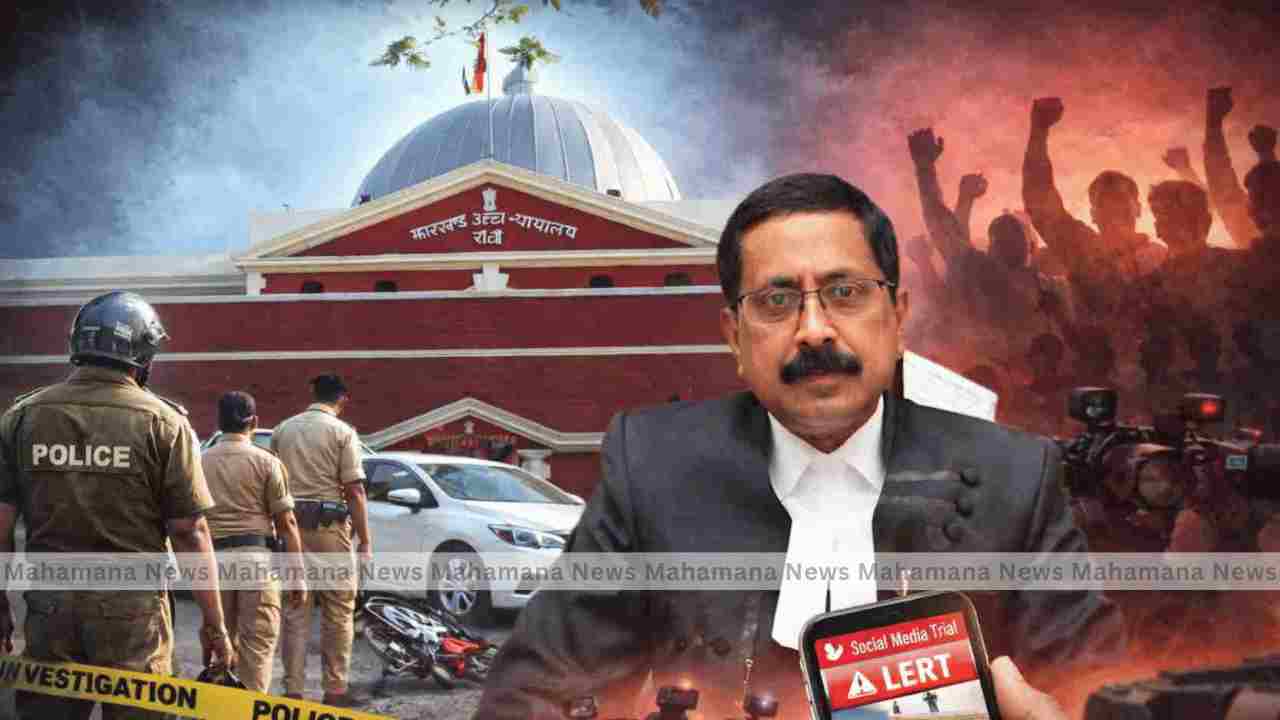
The Jharkhand High Court on February 19, 2026, stayed further investigation in two criminal cases arising out of a road accident in Ranchi and restrained the police from taking any coercive steps against the petitioner, observing that constitutional safeguards and arrest guidelines must be strictly followed.
Case Details
- Case Title: Manoj Tandon v. State of Jharkhand & Ors.
- Court: High Court of Jharkhand at Ranchi
- Case No.: W.P.(Cr.) Filing No. 4238 of 2026
- Bench: Hon’ble Mr. Justice Sanjay Kumar Dwivedi
- Date of Order: 19 February 2026
The interim order was passed in a writ petition seeking transfer of investigation in two FIRs registered at Doranda Police Station to the Central Bureau of Investigation (CBI), and protection against alleged police harassment.
Background
The petitioner, a practicing advocate of the High Court, stated that on February 17, 2026, while on his way to the High Court at around 10:00 a.m., a motorcycle suddenly came in front of his car, resulting in a minor collision.
An altercation allegedly followed, after which he was detained at Doranda Police Station from 10:00 a.m. to 5:00 p.m. His vehicle was taken into custody, though he alleged that no seizure memo had initially been prepared.
Two FIRs were registered arising out of the same occurrence:
- Doranda P.S. Case No. 51 of 2026, registered under Sections 281, 324(2), 125(b), 115(2), 117(2), 126(2), 351(2), 302, 351(3), and 3(5) of the Bharatiya Nyaya Sanhita, 2023.
- Doranda P.S. Case No. 52 of 2026, registered under Sections 281, 115(2), 126(2), 324(2), 19,2 and 3(5) of the Bharatiya Nyaya Sanhita, 2023.
The petitioner sought the transfer of the investigation of both cases to the CBI, alleging bias and an alarming situation in the city.
Allegations of Bias and Media Trial
Counsel for the petitioner argued that the two cross-cases were assigned to different investigating officers. It was contended that one investigating officer was allegedly conducting a “media trial” in connection with Doranda P.S. Case No. 51 of 2026.
It was also submitted that while the petitioner’s car was seized, the motorcycle involved had not been seized at that time.
The petitioner’s counsel further referred to the social media profile of the motorcycle rider and raised concerns regarding slogans allegedly associated with a banned organization, contending that the matter required investigation by a central agency.
The petitioner further alleged that a mob had gathered around his residence and the police station, and expressed apprehension that he could be taken into custody at any time.
It was argued that a telephonic call from the police station asking him to appear violated Supreme Court guidelines on arrest.
Arrest Guidelines Under Section 35(3) BNSS
The High Court noted that the petitioner alleged harassment
“in the absence of notice under section 35(3) of the BNSS, 2023”.
Justice Sanjay Kumar Dwivedi referred to the Supreme Court’s decision in Arnesh Kumar v. State of Bihar (2014) 8 SCC 273, observing that directions regarding arrest align with Sections 41 and 41A of the CrPC, now reflected in Section 35(3) of the Bharatiya Nagarik Suraksha Sanhita, 2023.
The Court also cited D.K. Basu v. State of West Bengal (1997) 1 SCC 416, emphasizing that arrest guidelines must operate within the framework of statutory provisions and the supervisory powers of the judiciary.
Further reliance was placed on Md. Asfak Alam v. State of Jharkhand (2023) 8 SCC 632, wherein the Supreme Court reiterated the Arnesh Kumar safeguards and directed strict compliance by State Governments, police authorities, and Magistrates. The High Court reproduced the Supreme Court’s directions, including:
“Failure to comply with the directions aforesaid shall, apart from rendering the police officers concerned liable for departmental action, they shall also be liable to be punished for contempt of court…”.
Investigation Cannot Be Stayed at FIR Stage, But Exceptions Exist
The Court acknowledged the settled legal position that an investigation at the initial stage of an FIR ordinarily cannot be stayed. It referred to the Supreme Court’s decision in Neeharika Infrastructures Pvt. Ltd. v. State of Maharashtra, 2021 SCC OnLine SC 315, where guidelines were laid down on passing interim orders in criminal matters.
The State sought four weeks to file a counter-affidavit. Counsel for the Union of India and the CBI also sought time to obtain instructions, stating that they would act in accordance with any direction of the Court.
On a query from the Bench, the State’s counsel submitted that seizure memos for both vehicles had been prepared.
Federal Structure and the High Court’s Constitutional Duty
Significantly, the Court made strong observations regarding the federal structure of the Constitution:
“The federal structure of our Constitution of India cannot be allowed to be destroyed and it is a duty of the High Court that once such type of matter is brought to the knowledge of the Court, the High Court is required to rise to the occasion.” .
The Court also noted that when two cases arise out of the same occurrence,
“both are required to be investigated by one investigating officer”.
Interim Relief: Stay on Investigation and Protection from Coercive Steps
Considering the gravity of the situation, the High Court passed the following interim directions:
- There shall be a stay of further proceedings, including investigation, in connection with Doranda P.S. Case No. 51 of 2026 and Doranda P.S. Case No. 52 of 2026.
- No coercive steps shall be taken against the petitioner in connection with Doranda P.S. Case No. 51 of 2026, pending before the Judicial Magistrate First Class-XIII, Ranchi, until the next date of listing.
- The Senior Superintendent of Police, Ranchi, was directed to take stock of the situation and ensure that no harm is caused to the petitioner.
The matter has been listed for further hearing on March 24, 2026.
Follow Mahamana News For More Recent Judgments