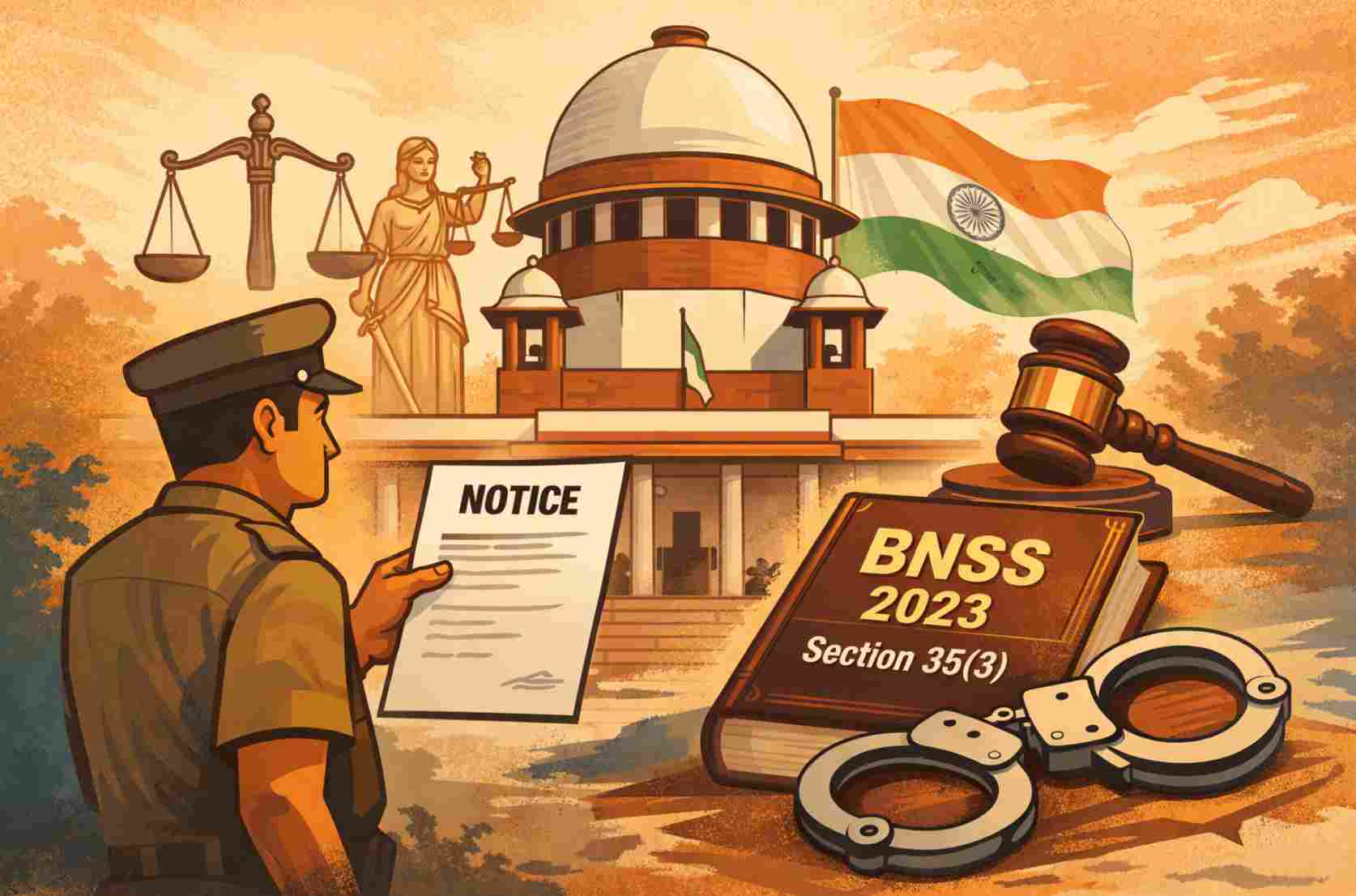
The Supreme Court has ruled that for offences punishable with imprisonment up to seven years, issuance of a notice under Section 35(3) of the Bharatiya Nagarik Suraksha Sanhita, 2023 (BNSS) is mandatory and arrest can only follow as an exception, subject to strict statutory conditions and recorded reasons.
The Supreme Court has once again emphasized that personal liberty under Article 21 cannot be curtailed mechanically.
The Court held that arrest “is not a matter of routine, but an exception,” and must be exercised with circumspection.
Case Details
- Case Title: Satender Kumar Antil v. Central Bureau of Investigation & Anr.
- Court: Supreme Court of India
- Bench: Justice M.M. Sundresh and Justice Nongmeikapam Kotiswar Singh
- Date of Judgment: January 15, 2026
- Citation: 2026 INSC 115
Background and Reference to BNSS, 2023
The matter arose from miscellaneous applications filed in a criminal special leave petition, where the Court was required to clarify the scope and operation of Section 35 of the BNSS, 2023, which has replaced Sections 41 and 41-A of the Code of Criminal Procedure, 1973.
The issue assumed significance in light of divergent interpretations emerging from High Court decisions, particularly the Bombay High Court’s judgment in Chandrashekhar Bhimsen Naik v. State of Maharashtra, and a pending writ petition before the same court on the mandatory nature of notice prior to arrest.
The Supreme Court framed the core issue as:
“Whether notices under Section 35(3) of the Bharatiya Nagarik Suraksha Sanhita, 2023 are to be mandatorily issued in all cases, qua an offence punishable with imprisonment up to 7 years?”
Submissions Before the Court
The amicus curiae submitted that “in the absence of specific circumstances under Sections 35(1)(b)(i) and 35(1)(b)(ii) of the BNSS, 2023, existing, an arrest by a Police Officer, qua an offence punishable with imprisonment up to 7 years, is not legally justified.”
Relying on Arnesh Kumar v. State of Bihar, it was argued that the requirement of issuing notice under Section 35(3) is absolute and “cannot be bypassed solely by recording reasons for arrest.”
The Union of India, through the learned Additional Solicitor General, countered that the position had already been settled by Arnesh Kumar and the earlier judgment in Satender Kumar Antil v. CBI, and that Section 35 itself contains inbuilt safeguards permitting arrest only when necessity is established.
Interpretation of Arrest Powers Under Section 35 BNSS
Analysing the statutory scheme, the Court noted that Section 35(1) uses the word “may,” making it clear that “the power of arrest is discretionary and optional.”
It held that Section 35(1)(b)(i) and Section 35(1)(b)(ii) must be read together, observing:
“Compliance with Section 35(1)(b)(i) of the BNSS, 2023 is a sine qua non in all cases of arrest.”
The Court explained that a mere “reason to believe” that an offence has been committed is insufficient.
In addition, the police officer must be satisfied that arrest is necessary for at least one of the purposes enumerated in Section 35(1)(b)(ii), such as preventing further offence, ensuring proper investigation, or preventing tampering with evidence.
Mandatory Nature of Notice Under Section 35(3)
The Bench repeatedly underscored that Section 35(3) reflects the legislative intent to avoid unnecessary arrests. It observed:
“Section 35(3) of the BNSS, 2023, once again, reiterates the object of the enactment that an arrest by a police officer is not mandatory in all cases.”
The Court clarified that for offences punishable with imprisonment up to seven years, Section 35(3) must be read harmoniously with Section 35(1)(b), and that issuance of notice is the norm.
It categorically held:
“A notice under Section 35(3) of the BNSS, 2023 to an accused or any individual concerned, qua an offence punishable with imprisonment up to 7 years, is the rule, while an arrest under Section 35(6) read with Section 35(1)(b) of the BNSS, 2023, is a clear exception.”
Effect of Compliance With Notice
The Supreme Court highlighted the protective intent behind Section 35(5), which bars arrest so long as the person complies with the notice.
The Court stated:
“As long as a person to whom a notice under Section 35(3) of the BNSS, 2023 is issued has complied and continues to comply with the terms of the notice then, as per Section 35(5) of the BNSS, 2023, it is not open for the police officer to arrest him unless, for reasons to be recorded, the police officer is of the opinion that he ought to be arrested.”
The judgment further clarified that even non-compliance with notice does not automatically mandate arrest. Referring to Section 35(6), the Court observed that arrest is “the last resort available to the Investigating Agency, after due exercise of discretion regarding the necessity of arrest.”
Arrest as an Exceptional Measure
Reiterating long-standing constitutional safeguards, the Court cited earlier precedent to emphasise that liberty cannot be curtailed casually. Quoting Joginder Kumar v. State of UP, the Bench recalled:
“The existence of the power to arrest is one thing. The justification for the exercise of it is quite another.”
The Court stressed that arrest cannot be used merely to facilitate questioning and that investigation can proceed without arrest.
It cautioned that any subsequent arrest after issuance of notice must be based on new circumstances that were not in existence at the time the notice was issued.
Judicial Endorsement of High Court View
Addressing the perceived inconsistency in the Bombay High Court judgment, the Supreme Court found no contradiction and expressly approved its approach.
It held that the High Court had correctly recognised the mandatory nature of notice and the exceptional nature of arrest under the BNSS framework.
Follow Mahamana News For More Recent Judgments