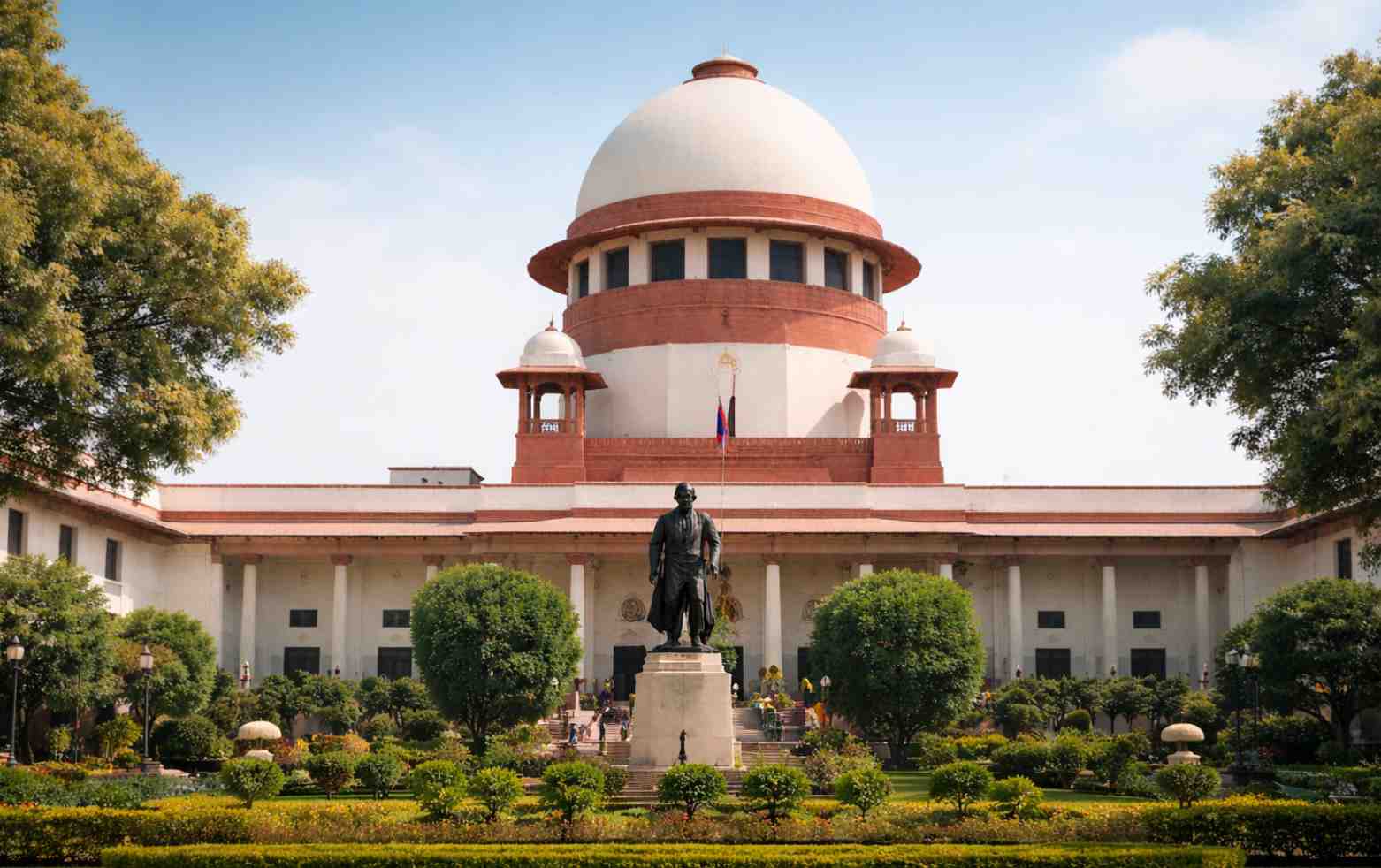
The Supreme Court has upheld an order of the Telangana High Court constituting an arbitral tribunal to adjudicate disputes arising out of an engineering, procurement and construction (EPC) contract awarded by Andhra Pradesh Power Generation Corporation Limited (APGENCO) to a consortium of companies led initially by Tecpro Systems Limited, holding that at the stage of appointment under Section 11 of the Arbitration and Conciliation Act, 1996, courts are required to undertake only a prima facie examination of the existence of an arbitration agreement and leave all contested jurisdictional and maintainability issues to the arbitral tribunal itself.
Case Details
- Case Title: M/s Andhra Pradesh Power Generation Corporation Limited v. M/s Tecpro Systems Limited & Others
- Citation: 2025 INSC 1447
- Court: Supreme Court of India
- Bench: Justice Pamidighantam Sri Narasimha and Justice Atul S. Chandurkar
- Jurisdiction: Civil Appellate Jurisdiction
- Case Numbers: Civil Appeal No. ___ of 2025 arising out of SLP (C) No. 8998 of 2023 & Civil Appeal No. ___ of 2025 arising out of SLP (C) No. 13200 of 2023
- Date of Judgment: 17 December 2025
- Impugned Order: Order dated 17 February 2023 passed by the High Court for the State of Telangana at Hyderabad in Arbitration Application No. 81 of 2019
- Statute Involved: Arbitration and Conciliation Act, 1996, Sections 11(6), 11(6A), and 16
- Nature of Dispute: Invocation of arbitration by an individual consortium member in an EPC contract dispute and the scope of judicial scrutiny at the Section 11 referral stage
- Final Outcome: Civil Appeals dismissed; constitution of arbitral tribunal upheld; all preliminary objections left open for determination by the arbitral tribunal
Dispute Over Consortium’s Right to Invoke Arbitration
The appeals before the Supreme Court arose from an order dated 17 February 2023 passed by the High Court for the State of Telangana at Hyderabad in Arbitration Application No. 81 of 2019.
By that order, the High Court, exercising powers under Section 11(6) of the Arbitration and Conciliation Act, constituted an arbitral tribunal to resolve disputes under Clause 22.2 of the General Conditions of Contract (GCC) governing an EPC contract for works at the Rayalaseema Thermal Power Plant.
APGENCO and VA Tech Wabag Limited, one of the consortium members, challenged the High Court’s order, contending that Tecpro Systems Limited, as an individual consortium member, lacked the contractual capacity to invoke arbitration.
According to the appellants, the arbitration agreement existed only between APGENCO and the consortium as a collective entity, not with any individual constituent company.
Background of the EPC Contract
The dispute traces its origins to a tender floated by APGENCO inviting bids from consortia for execution of an EPC contract.
The tender documents incorporated Instructions to Bidders and the GCC, which provided for arbitration as the dispute resolution mechanism under Clause 22.2.
In August 2010, a consortium comprising Tecpro Systems Limited, VA Tech Wabag Limited, and Gammon India Limited was constituted exclusively for participating in the tender, with Tecpro designated as the lead member .
The consortium emerged successful, and a Letter of Intent dated 30 October 2010 was issued, followed by three purchase orders dated 15 December 2010.
Each consortium member undertook a defined scope of work, while remaining jointly and severally liable under the contract. During execution, Tecpro faced severe financial distress, leading to project delays.
In 2014, VA Tech Wabag assumed Tecpro’s scope of work and was recognised as the lead member, with the consortium agreement amended accordingly.
Payments continued to be raised in Tecpro’s name for administrative convenience, though funds were disbursed directly to the respective members in agreed proportions.
In August 2017, Tecpro was admitted into the Corporate Insolvency Resolution Process, followed by liquidation.
Thereafter, disputes escalated between APGENCO and Tecpro regarding alleged delays and breaches of contract.
Tecpro claimed losses amounting to approximately ₹1,951.59 crore and, by letters dated 11 December 2017 and 3 April 2018, invoked the arbitration clause and nominated a former judge of the Supreme Court as its arbitrator.
APGENCO did not respond, prompting Tecpro to approach the High Court under Section 11(6).
Appellants’ Objections Before the Supreme Court
Before the Supreme Court, APGENCO and VA Tech Wabag advanced detailed submissions asserting that no arbitration agreement existed between APGENCO and Tecpro in its individual capacity.
They relied on the definitions in the GCC, which described the “Contractor” as the consortium whose tender had been accepted, arguing that only the consortium, and not an individual member, could invoke arbitration.
The appellants further contended that the purchase orders constituted the principal contracts and contained exclusive jurisdiction clauses in favour of civil courts at Hyderabad or Secunderabad, without any arbitration provision.
It was also argued that Tecpro had ceased to be the lead member in 2014 due to non-performance and later entered insolvency, making its unilateral invocation of arbitration contrary to the consortium framework.
The appellants relied on High Court judgments holding that individual consortium members cannot invoke arbitration without authorisation from other members, and on the Supreme Court’s recent decision in Cox and Kings Ltd. v. SAP India Pvt. Ltd. to argue that mutual intention to arbitrate could not be inferred contrary to express contractual terms .
Tecpro’s Defence of Its Right to Arbitrate
Tecpro Systems Limited countered that the purchase orders expressly incorporated the tender specifications and GCC, including the arbitration clause.
It argued that the jurisdiction clause in the purchase orders was not inconsistent with arbitration and merely indicated the seat of arbitration.
Relying on established precedents, Tecpro submitted that the arbitration clause stood validly incorporated by reference .
Tecpro further contended that the consortium was not a separate legal entity under Indian law and that its members retained independent contractual rights and obligations.
Payments were made directly to each member, and each had a severable scope of work.
According to Tecpro, objections raised by APGENCO related not to the existence of the arbitration agreement but to issues of entitlement and capacity, which fell squarely within the arbitral tribunal’s jurisdiction under Section 16 of the Act .
Supreme Court’s Analysis of Section 11 Jurisdiction
The Supreme Court, speaking through a Bench of Justices Pamidighantam Sri Narasimha and Atul S. Chandurkar, emphasised that the legislative scheme under the Arbitration and Conciliation Act, particularly after the insertion of Section 11(6A), confines the referral court’s enquiry to a prima facie determination of the existence of an arbitration agreement.
The Court reiterated that questions relating to jurisdiction, capacity, maintainability, and arbitrability are matters for the arbitral tribunal to decide under Section 16 .
Rejecting the appellants’ contention that the High Court should have conclusively decided whether Tecpro could invoke arbitration, the Court held that such an exercise would amount to conducting a “mini-trial” at the referral stage, contrary to the principles of minimal judicial intervention and kompetenz-kompetenz.
The Bench observed that whether a consortium member qualifies as a “veritable party” to the arbitration agreement depends on detailed examination of contractual terms and evidence, which lies within the tribunal’s domain.
Reliance on Prior Arbitration Proceedings
The Court also noted that disputes arising out of the same project, following the bifurcation of Andhra Pradesh and Telangana, had earlier been referred to arbitration by the Supreme Court itself in November 2021.
In those proceedings, a sole arbitrator had been appointed to consider claims involving Tecpro, VA Tech Wabag, Gammon India, and the successor power generation corporation.
The arbitral tribunal in that case had examined issues relating to Tecpro’s status as a party, underscoring that such questions are appropriately addressed within arbitral proceedings .
Dismissal of the Appeals
Concluding that the High Court had correctly confined itself to a prima facie assessment of the existence of an arbitration agreement, the Supreme Court found no error in the constitution of the arbitral tribunal.
It held that all preliminary objections, including whether Tecpro validly invoked arbitration, whether the consortium continued to exist, and the effect of Tecpro’s insolvency, could be raised before the tribunal under Section 16.
Accordingly, the civil appeals arising out of the High Court’s order dated 17 February 2023 were dismissed, with no order as to costs, affirming the pro-arbitration stance that referral courts must resist the temptation to delve into contested jurisdictional issues at the threshold stage.
Follow Mahamana News For More Recent Judgments