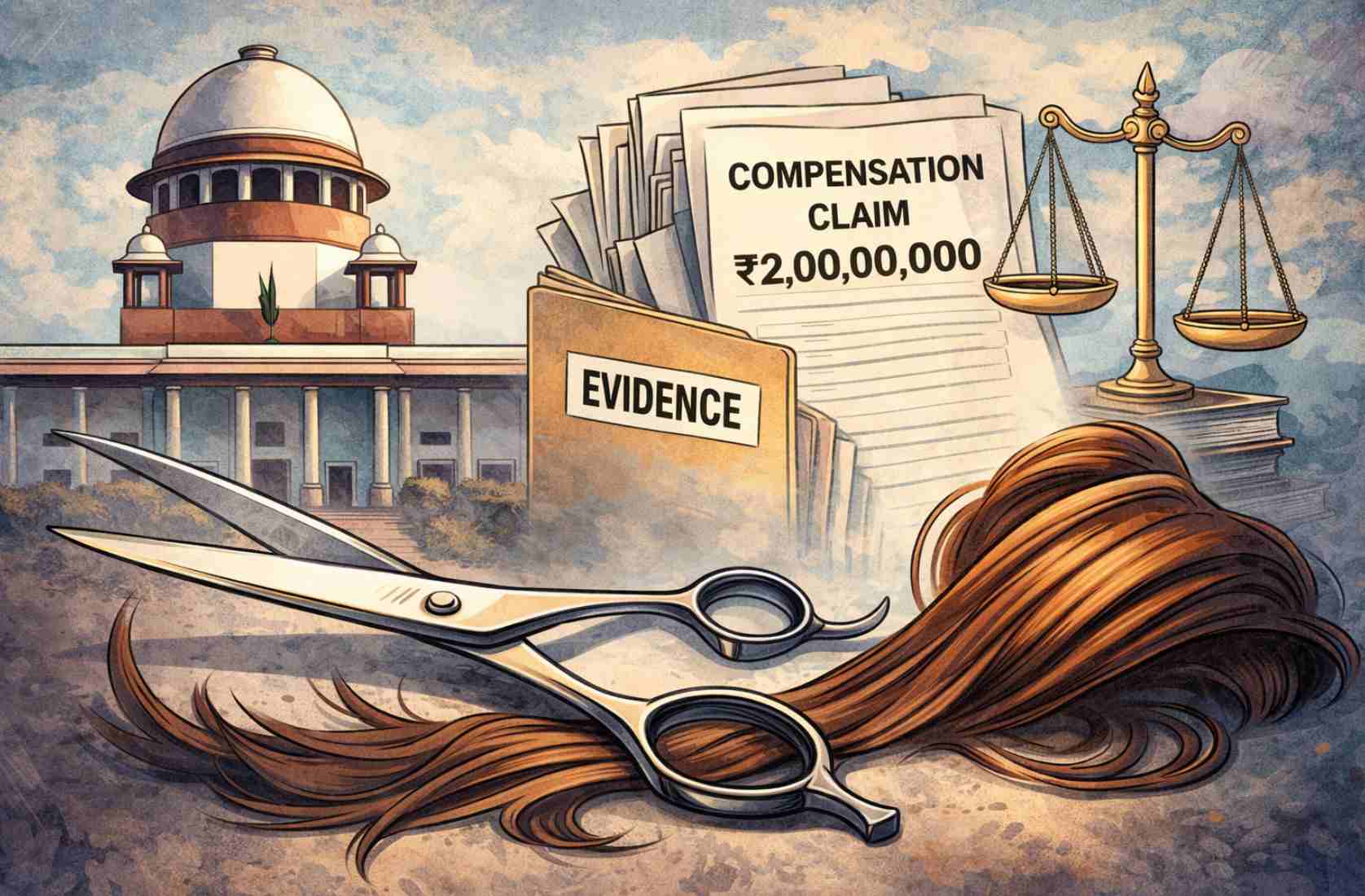
The Supreme Court has scaled down a ₹2 crore compensation awarded to a consumer who alleged a deficiency in service by a luxury hotel salon, holding that such a high amount could not be sustained in the absence of reliable and admissible evidence establishing actual loss.
Case Details
- Case Title: ITC Limited v. Aashna Roy
- Court: Supreme Court of India
- Bench: Justice Rajesh Bindal and Justice Manmohan
- Date of Judgment: February 6, 2026
- Citation: 2026 INSC 135
- Appeal: Civil Appeal No. 3318 of 2023
- Impugned Order: National Consumer Disputes Redressal Commission order dated April 25, 2023
Background of the Dispute
The dispute arose from a visit by the respondent, Aashna Roy, to a beauty salon operated by ITC Limited at its ITC Maurya Hotel in New Delhi on April 12, 2018, where she went for a haircut.
Dissatisfied with the service rendered, she filed a consumer complaint before the National Consumer Disputes Redressal Commission (NCDRC) in July 2018, alleging deficiency in service and medical negligence.
In September 2021, the NCDRC accepted her complaint and awarded compensation of ₹2 crore, holding ITC Limited guilty of deficiency in service.
The hotel chain challenged this decision before the Supreme Court.
Also Read: Presumption Under Section 85 Cannot Apply Without Proof of Secondary Evidence: Supreme Court
First Round Before the Supreme Court
In the first round of litigation, the Supreme Court, by judgment dated February 7, 2023, upheld the finding of deficiency in service recorded by the NCDRC.
However, the Court set aside the quantum of compensation, observing that the respondent had failed to place any material on record to justify the award of such a large sum.
The Court noted that compensation must be founded on evidence and not on mere assertions.
It therefore remitted the matter to the NCDRC solely for reconsideration of the quantum of compensation, permitting the respondent to adduce evidence in support of her claim and allowing ITC Limited an opportunity to rebut the same.
A sum of ₹25 lakh deposited by ITC Limited pursuant to interim orders was directed to be transmitted to the Commission. Subsequent review and curative petitions filed by ITC Limited against the remand order were dismissed.
Proceedings After Remand
Following remand, the respondent enhanced her claim from ₹2 crore to ₹5.2 crore and filed an affidavit along with photocopies of several documents.
These included emails allegedly relating to prospective senior-level corporate opportunities, certificates and letters from modelling agencies claiming high-value assignments, photographs from advertisements, pay slips from her corporate employment, and medical certificates asserting mental trauma and depression.
ITC Limited filed a detailed affidavit denying all the documents, contending that they were merely photocopies, many of them illegible, undated, or unsupported by originals.
The appellant also moved applications seeking production of original documents and permission to cross-examine the respondent, which, according to ITC, were not duly considered by the Commission.
Despite these objections, the NCDRC once again awarded ₹2 crore as compensation, with interest at 9% per annum from the date of filing of the complaint.
Also Read: Section 11 Courts Must Not Conduct ‘Mini Trial’ While Appointing Arbitrators: Supreme Court
Arguments Before the Supreme Court
ITC Limited contended that the Commission had acted in violation of principles of natural justice by relying upon unproven photocopies and by denying the appellant an opportunity to test the evidence through cross-examination.
It argued that the respondent had failed to establish any causal link between the alleged faulty haircut and her claimed loss of career opportunities, income, or professional standing.
The appellant pointed out that the respondent remained employed at the same salary both before and after the haircut, as reflected in her pay slips, and that none of the alleged modelling or film offers had been shown to have matured into actual contracts or resulted in proven financial loss.
The medical certificates, it was argued, lacked details of the doctor’s qualifications and were not contemporaneously produced.
The respondent, appearing in person, asserted that she was a highly qualified professional whose confidence and career prospects had been severely impacted.
She maintained that consumer fora are meant to adopt a liberal and consumer-friendly approach and that technical objections should not defeat substantive justice.
Legal Principles Considered
The Supreme Court reiterated that while strict rules of the Indian Evidence Act do not apply to proceedings under the Consumer Protection Act, 1986, consumer fora are nonetheless bound by the principles of natural justice.
The Court referred to earlier precedents clarifying that evidence may be led by affidavit, but where documents are disputed, their authenticity must be established through appropriate means.
The Court emphasized its earlier observation that
“quantification of compensation has to be based upon material evidence and not on the mere asking.”
Claims for compensation running into crores of rupees require trustworthy and reliable proof of actual loss.
Also Read: Supreme Court Forms Neutral SIT for Probe into Tribal Man’s Death Case
Supreme Court’s Analysis
Examining the evidence led after remand, the Court found that all documents relied upon by the respondent were photocopies, with none of the authors or issuing authorities examined or summoned.
No steps were taken to prove their genuineness, despite categorical denial by ITC Limited.
The Court noted that several documents predated the haircut, while others were created years later, and none conclusively demonstrated that the respondent had suffered financial loss attributable to the alleged deficiency in service.
The Court was particularly critical of the Commission’s reasoning that reliance could be placed on photocopies merely because the respondent may not have preserved originals due to trauma.
“The damages cannot be awarded merely on presumptions or whims and fancies of the complainant,”
the Court observed, stressing that high-value compensation must rest on clear proof of loss.
Final Decision and Directions
Allowing the appeal in part, the Supreme Court modified the NCDRC’s order and restricted the respondent’s entitlement to the amount already released in her favour, namely, ₹25 lakh.
The award of ₹2 crore compensation was set aside as unjustified and unsupported by evidence.
Follow Mahamana News For More Recent Judgments